

Search behavior has shifted dramatically, and the change affects every marketer competing for attention online. People increasingly type full questions into AI tools, then read a single summary instead of clicking ten separate links. That transition disrupts the traditional keyword playbook marketers have relied on for years. Small teams feel this shift first because they depend on free search traffic. AI keyword research is how you adapt your approach without abandoning everything you already know.
You still need keywords. You also need the questions, entities, and intentions that AI engines combine behind one response. Entities are simply the people, products, and concepts a topic involves. Map those three elements well, and your pages become easy for AI to quote. This guide explains how to identify them efficiently, without expensive tools or technical expertise.
Specifically, you will discover what AI keyword research is, why it matters, and a repeatable process for conducting it. You will also get tool recommendations, a practical checklist, and an overview of the common mistakes that quietly undermine results. Together, these sections strengthen your broader AI search engine optimization work.
Quick Answer
AI keyword research identifies the questions and topics that AI search tools draw from when generating answers for users. It combines classic keyword data with entity and question mapping. That data includes search volume (monthly searches) and intent (the reason behind a search). You assemble a full list, organize it by intent, then prioritize the terms your content can realistically win.
Key Takeaways
- AI keyword research identifies the questions, entities, and intents behind AI answers.
- It broadens classic keyword research rather than replacing it.
- AI engines fan out one query into many related searches simultaneously.
- Verify volume and difficulty with a real tool because AI invents numbers.
- Group related questions into clusters, then build one in-depth page for each.
- Match every term to its search intent before you assign content.
- Earn citations by writing extractable answers backed by specific, verifiable detail.
Table of Contents
What Is AI Keyword Research?

AI keyword research is the practice of identifying the questions and topics that AI search tools reference when constructing answers. Marketers also describe it as AI search keyword research or generative keyword research. The underlying objective remains familiar. You still match audience demand with content you can rank for and get cited in. Cited means AI answers name your page as a source.
Conventional search returns a list of links for one phrase, while AI search returns a combined answer from many sources. That structural change fundamentally reshapes what you research because you no longer chase one isolated term. Instead, you map the complete set of questions surrounding a topic, which explains why thin, single-keyword pages now underperform.
Traditional keyword research targets a single phrase per page, while AI keyword research targets a cluster of related questions. It still relies on the same core metrics, so you are refining a familiar craft rather than learning a new one. The two approaches differ in three practical ways:
- Scope: Classic research targets a head term (a broad keyword), while AI research targets a topic and its sub-questions.
- Data: You still use search volume and keyword difficulty (ranking competition for a term).
- Output: You map a question cluster to one strong page, rather than one keyword to one page.
Picture a bakery researching custom cakes, where conventional research might target the phrase custom cakes. AI research, on the other hand, maps the surrounding cluster: pricing, flavors, lead times, and dietary options. You also track the entities each question involves. This gets easier once you understand how AI search engines work. At its core, AI keyword research is content optimization aimed at AI answers.
Why AI Keyword Research Matters Now
AI search has gone mainstream, and the adoption numbers confirm it. Approximately 44% of US adults have used ChatGPT, while 60% now read AI-generated summaries in search results (Pew Research Center). So your keywords must now reach generated answers, not only traditional rankings. Many users now read the AI Overview, the AI summary shown above the usual links, and never click through.
AI engines also expand a single question into many through a process called query fan-out (Search Engine Land). A single query simultaneously triggers several related searches behind the scenes. Google confirms that its AI features issue multiple related searches before generating a response (Google).
Imagine someone searching for the best running shoes for flat feet. The engine may quietly investigate stability shoes, arch support, and leading brands, then merge those findings into one answer. A page addressing only the original phrase can therefore be excluded entirely.
Query fan-out rewards content that fully covers a question cluster, which reshapes how you approach research. That shift translates into three practical adjustments:
- Think in terms of topics and questions rather than isolated phrases.
- Cover closely related sub-questions on the same page.
- Write clear, direct answers that an engine can extract and cite.
The lesson is straightforward: build pages that answer the entire cluster, not a single keyword. That broad coverage earns visibility and citations within AI answers, although a strong ranking alone no longer guarantees a citation. Different phrasings of the same need point to a single intent, so thorough coverage matters more than exact wording (Similarweb). This is the keyword layer beneath answer engine optimization, the practice of getting content quoted directly. It also supports broader AI search optimization.
How AI Keyword Research Works: Step by Step

AI keyword research follows a clear, repeatable sequence that moves you from broad topics toward a short, prioritized list. Each step feeds the next, so the order matters. Treat the whole sequence as a workflow you can complete in a single afternoon. Follow these steps:
- Begin with seed topics. List the core subjects your business serves. These broad seed terms feed every subsequent step. Phrase each as a real question someone would ask an AI tool.
- Collect questions and entities. Extract real questions from People Also Ask (the related-question box in search results), AI chats, and customer emails. Thorough audience research accelerates this step.
- Map search intent for each term. Sort them by goal: informational (learning), commercial (comparing), navigational (finding a site), or transactional (buying) (Semrush). Intent decides the page type, so let it guide what you build.
- Organize related terms. Group questions that share a single answer into one topic. This includes long-tail keywords, the longer and more specific phrases buyers actually type.
- Pull real metrics. Add search volume and difficulty from a dedicated keyword tool. AI alone fabricates these numbers, so always verify them (Ahrefs).
- Prioritize the results. Rank terms by value, intent, and your odds of winning them. Keep the strongest few, and reserve the rest for later.
Run these steps for every seed topic. The output becomes a short, ranked list grounded in real demand. Revisit it whenever you publish fresh content or notice a ranking shift. Aim to cover each topic from several angles: definitions, comparisons, how-to steps, and common objections.
Tools and Data Sources for AI Keyword Research
No single tool performs AI keyword research alone. You combine a keyword database, an AI assistant, and live search features because each addresses a distinct gap. The table below summarizes how they fit together:
| Tool type | Best for |
|---|---|
| Keyword tools (Ahrefs, Semrush) | Real volume, difficulty, and intent data |
| AI chat tools (ChatGPT, Claude, Gemini) | Expanding seed topics into question clusters |
| Search features (People Also Ask, AI Overviews) | Seeing the questions engines surface live |
| Your own data (Search Console, customer questions) | Finding terms you already earn or miss |
| AI visibility trackers | Checking whether AI answers cite your pages |
In practice, you layer these resources deliberately. Begin in a keyword tool to pull verified volume, difficulty, and intent. Move to an AI assistant to expand seeds and cluster questions rapidly. Tools such as AlsoAsked then automatically map those related questions. Finally, examine your own Search Console (Google’s free search report) for terms you already touch. Then track whether AI answers currently cite your pages.
AI assistants require a connected data source to generate reliable metrics (Ahrefs). Without one, they fabricate figures for volume and difficulty. Always pair them with a reliable database, then incorporate the validated output into your SEO strategy. Free tools can get you started, although paid databases provide fuller data.
Select tools proportionate to your budget and current stage of growth. A free keyword tool plus one AI assistant covers most early needs. Add a paid database once you publish regularly and need deeper data. Your own Search Console stays free and remains the most honest signal you own. Start small, then upgrade only where guesswork is costing you real traffic.
How to Build and Execute Your Strategy
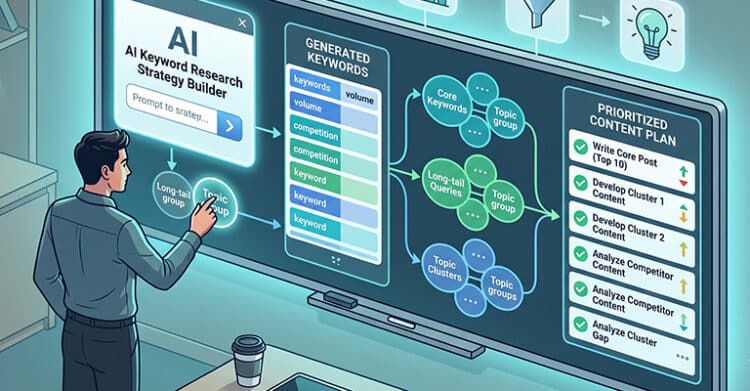
A keyword list is not yet a strategy, because you also need rules that convert research into published pages. Your strategy weighs each term against its potential value and the effort required. Use these if/then rules to decide quickly:
- If a term has high volume but heavy competition, then target a long-tail variation first.
- If two keywords share the same intent and answer, then cover them on a single page.
- If a query triggers an AI Overview, then lead your page with a short, direct answer.
- If a term sits far outside your expertise, then skip it or build authority first.
Once your list is prioritized, assign each cluster to a single page. Then note the questions, entities, and intent for whoever writes the page, even if that is you. This discipline keeps your content marketing and AI content strategies aligned.
Place each page on your publishing schedule, then give it one primary question alongside a few supporting ones. Write the direct answer first, then layer in the depth a full cluster needs. Mark each page as a traffic play or a citation play. Traffic plays chase clicks, while citation aims to be quoted in AI answers.
Finally, measure what actually works by tracking which clusters earn citations, AI Overviews, and clicks. Double down on the winners and refresh the underperformers. Remember that strategy operates as a continuous loop, not a single pass.
Keep the improvement loop small enough to sustain consistently. Publish one cluster, measure it, and learn before starting the next. A single authoritative page frequently outperforms five thin, superficial ones. Review your results monthly, and let real data decide what to build next. Consistent, focused output beats an unsustainable burst of activity.
What Makes Content Earn AI Citations
Earning a citation is not a matter of luck because AI engines favor content they can extract and trust. None of the required techniques demands new tools. Three signals raise your odds the most:
- Extractable passages: let each heading answer one specific question so that an engine can lift a clean passage.
- Citation density: include specific numbers, named sources, and dates because verifiable detail signals credibility.
- Clear structure and entities: use plain headings and name the people, products, and concepts involved.
These habits compound over time. Princeton research found that adding statistics and citations can increase the visibility of AI answers by up to 40% (Princeton). Thin, generic pages get skipped, so lead with the answer, then provide the supporting depth. This work belongs to generative engine optimization, the broader practice of earning AI citations.
Applying these principles is simpler than it initially sounds. Open one published page and read its first lines under each heading. If a heading does not answer its own question quickly, rewrite it. Add one verifiable figure, name its source, and define any term on first use. These small edits make your passages far easier to quote.
Say a reader asks about email open rates. A strong passage states the benchmark, names the source, and explains it in plain language. An engine can quote that directly, whereas a vague paragraph without numbers gives it nothing to cite. Structure and clear evidence make the difference every time. Aim for that clarity on every page, and citations follow naturally over time.
Common AI Keyword Research Mistakes

Trusting numbers the AI made up
Many users ask a chatbot directly for search volume and difficulty figures. The catch is that AI tools fabricate these numbers whenever they lack a connected data source (Ahrefs). Consequently, you pursue terms that nobody actually searches for. The remedy is straightforward. Connect your AI tool to a real keyword database, or pull metrics from a dedicated platform first. Then let AI help you sort and group them.
Targeting one keyword instead of a cluster
Old habits push you toward choosing a single phrase per page. However, AI engines fan out one question into many related searches (Search Engine Land). A page constructed around just one keyword, therefore, misses most of them. Instead, group related questions that share a common answer. Build a single, thorough page that covers the entire cluster so it can surface for dozens of queries.
Ignoring search intent
Collecting terms while forgetting why people search them is a frequent error. For that reason, the search intent determines the appropriate page type (Semrush). Match a how-to query with a guide, not a product page. When intent and format clash, your page gets skipped entirely. Therefore, confirm intent for every term before assigning it to content.
Skipping the data you already own
Public tools overlook the terms you already earn or lose in search. Your Search Console and customer questions hold exactly that data. Ignoring them leaves you guessing without any solid evidence. Begin every project by exporting your own queries. Then pair that audience research with tool data for a fuller, more accurate picture of your opportunities.
Writing for pages instead of passages
Some writers optimize the entire page yet ignore its internal structure. The problem is that AI engines extract short passages rather than complete articles (Princeton). A dense wall of text gives them nothing clean to lift. The fix is structural. Let each heading pose one question and answer it directly in the first sentence. Then your passages travel cleanly into AI answers.
People Also Ask
Is AI keyword research different from traditional keyword research?
It is fundamentally the same craft viewed through a wider lens. Traditional research targets one phrase per page. AI keyword research targets a topic and the cluster of questions surrounding it. You still evaluate volume, difficulty, and intent throughout. The primary change is in scope: you now map a group of related questions to a single strong page.
Can ChatGPT do keyword research on its own?
Not reliably on its own. A chatbot can expand topics and group questions effectively. However, it fabricates volume and difficulty whenever it lacks a connected data source (Ahrefs). Connect it to a proper keyword database, or paste in the tool data first. It then becomes a fast, capable research assistant rather than an unreliable number-guesser.
What is query fan-out in simple terms?
Query fan-out occurs when an AI engine turns one question into several related searches simultaneously. It then blends those results into a single answer. Consequently, a page covering only your main keyword can be excluded. Pages that answer the entire cluster perform far better. They are more likely to be retrieved and cited in the response.
How many keywords should one page target?
Think in clusters rather than exact counts. One page should own a primary question plus the closely related questions that share its answer. That might mean one main term alongside several supporting ones. If a question requires a clearly different answer or page type, give it a dedicated page instead of overstretching one.
Do keywords still matter in AI search?
Yes. AI features still operate on core search systems, so SEO fundamentals remain relevant (Google). Keywords reveal your audience’s language, questions, and intent. AI keyword research broadens that work to cover question clusters and entities, not phrases you hope to rank for. The fundamentals continue to compound across every engine.
Your AI Keyword Research Checklist
Use this checklist to run the full process. Work from top to bottom, and tick each task as you complete it.
| Done | Task |
|---|---|
| ☐ | List your core seed topics. |
| ☐ | Gather questions from People Also Ask, AI chats, and customers. |
| ☐ | Note the entities in each question. |
| ☐ | Tag every term with its search intent. |
| ☐ | Pull real volume and difficulty from a tool. |
| ☐ | Group related questions into clusters. |
| ☐ | Prioritize by value, intent, and winnability. |
| ☐ | Assign one cluster to one page. |
| ☐ | Note questions, entities, and intent before writing. |
| ☐ | Track which clusters earn AI citations |
Conclusion
AI keyword research is not entirely new. It is your familiar keyword work, broadened to fit how AI engines answer. Start with seed topics, map the questions and their intent, then carefully verify your metrics. Build comprehensive pages for clusters and track which earn citations. For the bigger picture, each cluster you build strengthens your broader AI search engine optimization plan. Pick one topic this week and run the complete process from start to finish. Keep your initial attempt deliberately small, and complete it thoroughly. One completed cluster teaches more than a perfect plan that you never start. Momentum, not perfection, builds your visibility in AI search.
Frequently Asked Questions
What is AI keyword research?
AI keyword research identifies the questions, topics, and entities that AI search tools rely on when constructing answers. It combines familiar metrics, including search volume and intent, with deliberate question mapping and entity coverage. The objective is to match what your audience asks AI tools with content you can realistically rank for. Done well, it helps your pages earn citations and attract steady, qualified traffic. That visibility is the true prize.
How is AI keyword research different from SEO keyword research?
The two disciplines share an identical foundation, so you are certainly not starting over. Standard SEO keyword research frequently targets one phrase per page. AI keyword research instead targets a topic and the surrounding cluster of related questions. You still weigh volume, difficulty, and intent throughout the entire process. The essential shift is scope, because AI engines expand a single query into many related searches before answering.
Which tools are best for AI keyword research?
Use a deliberate combination rather than a single tool. Keyword databases like Ahrefs and Semrush supply verified volume, difficulty, and intent data. AI chat tools rapidly expand seed topics into structured question clusters. Live search features, such as People Also Ask, reveal the questions engines actually surface. Pair these sources with your own Search Console data, so you consistently build on evidence rather than guesswork. No single tool covers the entire job.
How do I find the questions AI engines use?
Begin with the surfaces your audience already encounters daily. People Also Ask boxes, AI Overviews, and related searches expose actual questions immediately. Ask AI chat tools to quickly expand a seed topic into related queries. Then incorporate your own customer emails and Search Console terms for additional context. Together, these sources reveal the cluster of questions that one strong page should answer, as well as the entities it should mention.
Does search volume still matter for AI search?
Yes, it still guides where you invest your limited effort. Volume indicates how many people search for a term each month, helping you prioritize with confidence. The complication is that AI tools frequently invent volume whenever they lack a data source. Therefore, pull volume from a trusted keyword database first. Then use AI to sort, cluster, and prioritize the terms that truly matter to your business. Verified data keeps your priorities honest.
How long does AI keyword research take?
It depends on your topic and tools, although the core process is quick. A single cluster can take an hour or two once you understand the steps. Larger topics with many sub-questions naturally require longer to map thoroughly. Still, the effort pays off through coverage. One well-researched cluster can guide a page answering dozens of related queries, not one phrase at a time. The coverage compounds over time.
Can small businesses compete in AI search?
Yes, and clusters are precisely how you accomplish it. You will not outspend large brands on every competitive head term. However, you can own narrow, specific question clusters that align with your expertise. Long-tail questions face less competition and signal clearer intent. Answer them thoroughly and clearly, and AI engines can cite you, even when bigger competitors target the broader terms. Specific, experienced answers become your lasting advantage.
How often should I redo keyword research?
Treat it as an ongoing habit rather than a one-time task. Review your core clusters every few months because questions and competition continually shift. Revisit a topic sooner whenever you publish a new page or notice a ranking decline. AI search evolves rapidly, so a light, regular check keeps your clusters up to date. Consistency easily beats occasional, heavy overhauls, and a quick quarterly review is usually enough. Small updates stay manageable.
Glossary
These terms appear throughout the guide. They pair well with the wider digital marketing glossary.
| Term | Definition |
|---|---|
| AI keyword research | Identifying the questions, topics, and entities that AI search tools use to build answers. |
| Query fan-out | When an AI engine turns one question into several related searches before answering. |
| Search intent | The reason behind a search, such as learning, comparing, or buying. |
| Entity | A person, place, product, or concept that a topic involves. |
| Seed keyword | A broad starting term that you expand into more specific related queries. |
| Long-tail keyword | A longer, more specific phrase that often signals clearer intent. |
| Keyword difficulty | A score estimating how hard it is to rank for a term. |
| Topic cluster | A group of related questions that share one answer and one page. |
| Answer engine optimization | Shaping content so engines can extract and cite a direct answer. |
| AI Overview | An AI-generated summary is shown above standard search results. |
| AI citation | A mention or link to your page inside an AI-generated answer. |
| Passage extractability | How easily an AI engine can lift a clean answer from your page. |