Quick Answer
AI search optimization is the practice of structuring content, entities, and brand signals to optimize for AI search engines. The aim is to get cited by ChatGPT, Perplexity, Google’s AI Overviews, and similar tools. It targets citation frequency, not keyword rankings. Wins come from answer-first formatting, entity clarity, structured data, and brand mentions earned across the open web.
Key Takeaways
- AI search optimization targets citations inside AI-generated answers, not classic rankings.
- Roughly 60% of searches now end without a click, so visibility inside the answer matters more than position.
- Brand mentions across the open web are now more influential than backlinks for AI visibility.
- Schema markup, FAQ blocks, and clear definitions raise your chances of being cited.
- Each AI engine cites differently: ChatGPT rewards depth, Perplexity rewards recency, and Google rewards authority.
- Track citations and brand mentions monthly. Position tracking does not work in AI search.
- Your traditional SEO foundation still matters since AI engines crawl the same open web.
Table of Contents
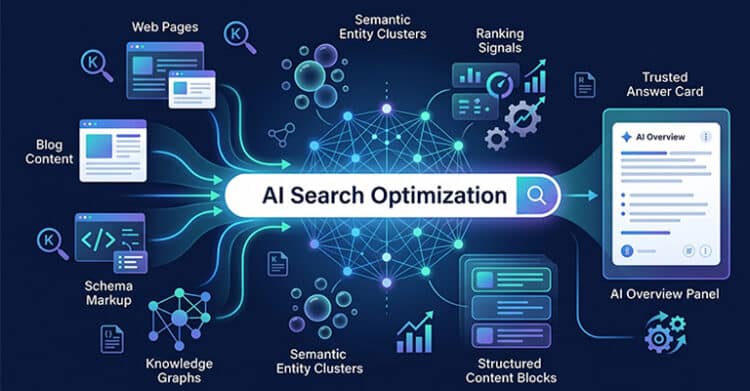
You search for an answer. ChatGPT gives you one. Perplexity adds sources. Google shows an AI Overview before any blue links.
This is the new front door to the web. And it does not work like classic search.
Most marketing advice still treats Google rankings as the only goal. That assumption is changing fast. Your readers now ask AI engines first. The brands they meet are the ones cited inside those answers.
This guide walks you through AI search optimization step by step. You will learn what AI engines look for, how they choose sources, and how to structure your content. You will also get a clear checklist that you can apply this week.
What Is AI Search Optimization?
AI search optimization is the practice of making your content visible in AI search results. You may also see it referred to as generative engine optimization (GEO), answer engine optimization (AEO), or large language model optimization (LLMO).
It shares many tactics with traditional search engine optimization, but the goal is different.
Where SEO targets a ranking, AI search optimization targets a citation. A citation is a mention or link to your page inside an AI-generated answer. The reader may never click. The brand still wins by being named.
Three goals drive this work:
- Discovery: AI engines find and crawl (visit and scan) your page.
- Understanding: They read your entities, claims, and structure.
- Trust: They judge your content worthy of citing.
Most SEO fundamentals carry over. Quality content, technical health, and strong authority still matter. The new layer is structure, entities, and brand mentions shaped for AI engines.
Why AI Search Optimization Matters Now

The shift is faster than most marketers realize. AI search traffic has grown roughly 527% year over year (Semrush). Google AI Overviews now reach over 2.5 billion monthly users (CNBC).
Roughly 60% of searches now end without a click. AI summaries answer questions on the results page (Forbes).
About 80% of consumers rely on zero-click AI summaries for at least 40% of their searches (Bain). The reader’s path to your brand is changing, even when they never click.
Revenue can grow even when traffic drops. NerdWallet reported 22% revenue growth across full-year 2025, even as AI search reduced organic traffic across multiple quarters (NerdWallet).
If your strategy relies only on top-10 rankings, much of your visibility now sits outside your control. AI search optimization is the work that protects your reach as user behavior changes.
How AI Engines Choose Sources
Different AI engines use different rules. Knowing how each engine works helps you write content that fits multiple platforms at once.
Google AI Overviews and the Authority Pattern
Google AI Overviews lean on traditional ranking signals (the factors Google uses to order results) plus brand authority. Strong organic ranking (your position in regular Google search results) still predicts inclusion. Schema markup (code that helps engines interpret your content) and clear E-E-A-T signals (experience, expertise, authoritativeness, trustworthiness) strengthen both factors.
ChatGPT and the Topical Authority Pattern
ChatGPT favors topical depth over keyword repetition. Topical authority means broad and deep coverage of a subject. Authors and brands that have covered a topic extensively get featured more often. Encyclopedic, well-structured pages and Wikipedia-style references show up most often in ChatGPT’s citations.
Perplexity and the Source-Transparency Pattern
Perplexity ties answers to specific sources. It favors recent content and draws from a broader mix of sources, including Reddit, forums, and niche industry sites. Clear citations and well-sourced claims help here.
AI engines also use a technique called query fan-out. They split a user question into related sub-queries and stitch passages from multiple sources. Cover a topic with depth, not just one page.
If you want broad AI visibility, write for all three patterns. Clear definitions, sourced claims, structured headings, and consistent brand entities help across every engine.
The Five Pillars of AI Search Optimization
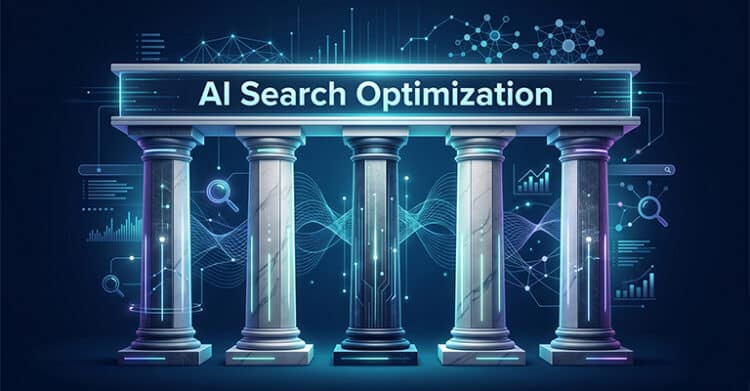
A complete AI search optimization strategy rests on five pillars. Each pillar reinforces the others.
- Content structure that AI can extract.
- Entity clarity that AI can interpret.
- Authority signals that AI can trust.
- Technical foundations that AI can crawl.
- Multi-surface visibility that AI can find off-site.
Skip any pillar and your results stall. A well-structured page with no entity clarity stays invisible. Strong entities do not help if your authority signals are weak. Even strong authority falls short if AI crawlers cannot reach your page.
If you are starting from scratch, begin with content structure. Structure compounds the value of every other pillar.
| Pillar | What It Controls |
|---|---|
| Structure | Whether AI can provide a clean answer |
| Entities | Whether AI knows what your page is about |
| Authority | Whether AI trusts your page enough to cite |
| Technical | Whether AI can reach your page at all |
| Multi-Surface | Where AI finds your brand off-site |
Content Structure That Earns AI Citations
Structure is your fastest lever. AI engines prefer content they can read cleanly. An answer-first format gives them what they need without scrolling.
The Answer-First Framework:
- Open every section with the direct answer in two or three sentences.
- Follow with supporting context, data, and examples.
- Close with related questions or considerations.
Use this structure across the article:
- A 40-to-60-word direct answer near the top of the page.
- Short paragraphs of two to four sentences each.
- H2s and H3s that ask and answer real user questions.
- Lists, tables, and steps for extractable data.
- Definitions stated in one clean sentence.
- An FAQ block targeting long-tail questions.
Original data also raises your odds of citation. Pages with precise, citable statistics tend to be cited far more often than vague claims. The same content optimization principles that strengthen any page apply directly to AI search.
If a section reads like a paragraph essay, add a list, definition, or table. The cleaner the format, the more accurately AI can quote you.
Entity Optimization and Topical Authority
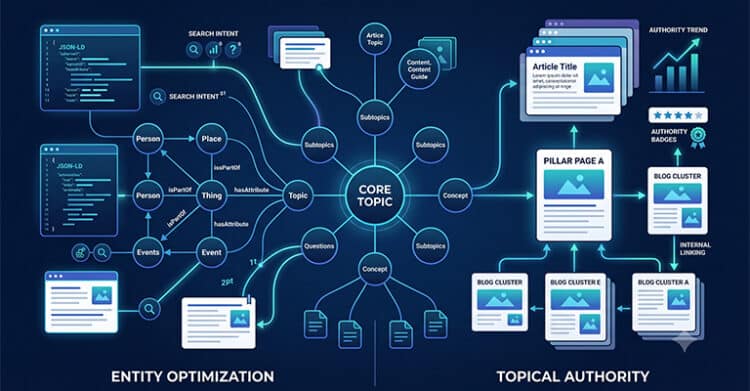
An entity is anything AI engines can recognize: a person, brand, product, place, or concept. Entity optimization is now foundational for AI visibility (Forbes).
Three moves strengthen your entity layer.
Name Things Clearly
Use the canonical name in your title, H1, first 100 words, and at least one H2. The canonical name is the official version of an entity’s name. Mention synonyms once, then stick to the canonical term. AI engines reward consistency, not variety.
Map Relationships Explicitly
State how entities connect. For example, AI search optimization requires schema markup. Schema markup helps AI engines interpret your content. These relationship sentences feed the knowledge graph that AI engines build (the connected web of entities and relationships).
Build Topical Authority Through Content Clusters
Group related pages around a pillar page (your main, comprehensive guide to a topic). Connect them with internal links that use entity-based anchor text (the clickable words inside a hyperlink). The cluster signals depth and enables AI engines to extract multiple passages from a single trusted source.
Reinforce your entity signal across Google Business Profile, Wikidata, and major directories. These tactics support the wider answer engine optimization strategy.
Authority Signals That Drive AI Visibility
AI engines now weigh brand authority more than backlinks (links from other websites pointing to yours) alone. Research shows that brand mentions are roughly three times as influential as backlinks for AI search visibility (Hallam).
That shift turns digital PR into core SEO work, not a nice-to-have. Digital PR means earning mentions in news, podcasts, and industry publications. Authority sits in three buckets.
| Bucket | Examples |
|---|---|
| Brand mentions | Industry sites, news, podcasts, forums |
| Branded search | People searching your name directly |
| Citations and quotes | Statistics, methods, or quotes others reuse |
Four actions build authority steadily:
- Earn mentions in roundups, podcasts, and guest posts in your niche.
- Publish original data or simple frameworks others want to cite.
- Maintain consistent name, role, and topic across every platform.
- Pursue earned coverage in trade publications and industry reports.
If only your own site talks about you, then AI engines have one weak signal to evaluate your brand. Pair on-site work with steady off-page SEO to widen the signal base.
Technical Foundations for AI Crawlability
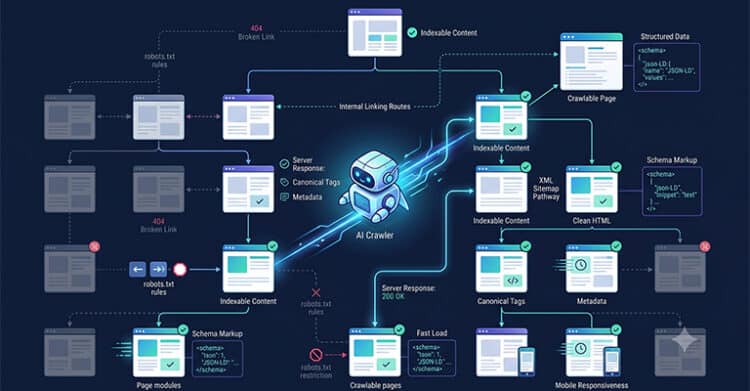
Technical SEO still matters. AI engines crawl the same way Googlebot (Google’s web crawler) does, and many also use their own bots. The same technical SEO foundations apply directly to AI visibility.
Cover the basics first:
- A clean XML sitemap (a file listing all your pages for crawlers) submitted to Google Search Console.
- Mobile-friendly layout and fast Core Web Vitals (Google’s page speed and stability metrics).
- Crawlable navigation with no broken internal links.
- Logical URL structure that mirrors topical clusters.
Then add the AI-specific layer:
- Schema markup for Article, FAQPage, HowTo, Organization, and BreadcrumbList where they fit.
- A clear robots.txt (the file that tells crawlers which pages they can visit) that allows known AI crawlers.
- An llm.txt file to signal which content is available for AI retrieval.
- Open Graph data (tags controlling social media previews) and meta tags (page descriptions for search engines) that match your H1 and primary entity.
Pages with proper schema markup tend to appear in AI-generated answers far more often than pages without it (Semrush). Google’s structured data guidance documents each schema type and the required properties.
If your robots.txt blocks all bots, then no AI engine can crawl, parse, or cite your content. Treat technical work as ongoing baseline maintenance, not a one-time fix.
Multi-Surface Visibility: Search Everywhere
AI engines now cite more than just blog posts. They pull from YouTube transcripts, Reddit threads, Quora answers, and podcast transcripts. SEO has evolved from “search engine optimization” to “search everywhere optimization”.
Surfaces worth covering:
- YouTube: Record video content on core topics. Transcripts feed AI training data.
- Reddit: Participate in relevant subreddits with helpful, non-promotional answers.
- Podcasts: Appear on industry podcasts and publish transcripts on your site.
- LinkedIn: Publish thought leadership on professional topics regularly.
- Review platforms: Earn and manage reviews on G2, Capterra, or Trustpilot.
User-generated content (reviews, forum posts, and community discussions) is a strong AI signal because it captures real human experience. Brands that integrate community voices into their content show up across more surfaces where AI engines look.
If you only publish on your own blog, then AI engines have one place to find you. Multi-surface presence gives AI more places to discover and cite your brand.
Common AI Search Optimization Mistakes
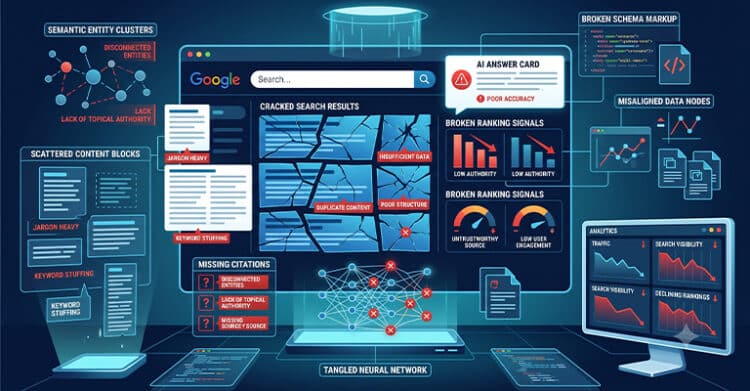
Most AI visibility problems come from a few repeat patterns. Catching them early saves months of slow growth.
Writing for Keywords Only
You target the keyword but skip the underlying question. AI engines need the answer, not the same keyword repeated over and over. Map content to search intent first, then check keyword usage.
Burying the Answer
The reader scrolls past 500 words of intro to reach the takeaway. AI engines rarely lift answers buried that deep. Place your direct answer block near the top of the page, ideally within the first 100 words.
Ignoring Entities
You name a concept once, then drift into pronouns and alternate phrasings. AI engines lose track of what your page is about. Use the canonical entity name throughout, not creative variations.
Skipping Off-Site Authority
You optimize the page, but you’re never mentioned anywhere else. The page reads well and stays invisible. Today, brand mentions across third-party sites and backlinks do real work for AI visibility.
Treating All Platforms the Same
You assume one strategy fits ChatGPT, Perplexity, and AI Overviews. Each one weighs sources differently. Optimize for Google AI Overviews first since it weighs both ranking and brand authority, then adjust for ChatGPT and Perplexity.
Start with the answer-first structure. Most other mistakes become easier to spot once that piece is in place. A short review of these five patterns usually reveals the biggest gaps.
Tools and Resources for AI Search Optimization
A few categories of tools cover most needs. You do not need every category from day one.
| Tool Type | What It Does |
|---|---|
| AI visibility tracker | Tracks citations and brand mentions in ChatGPT, Perplexity, and AI Overviews |
| SEO platform | Keyword research, backlink data, technical audits |
| Schema generator | Creates structured data markup for your pages |
| Brand mention tracker | Surfaces unlinked and linked third-party mentions |
| Google Analytics 4 (GA4) | Isolates referral traffic from AI engines via custom channel groups |
New metrics worth tracking:
- Share of AI Voice: How often your brand appears across target prompts.
- Citation frequency: How often your content is cited per topic.
- Brand mention volume: Unlinked and linked mentions across the web.
- AI referral traffic: Sessions from ChatGPT, Perplexity, Copilot, and Claude.
Position tracking does not work in AI search. Studies show less than a 1% chance of the same brand list appearing twice across prompts. Watch trends in citation frequency instead. A digital marketing glossary helps when new terms appear in your tracking tools.
People Also Ask About AI Search Optimization
Will AI search replace traditional SEO?
Not anytime soon. Traditional search still drives most website traffic for most brands. AI search is growing fast, but it works alongside Google and Bing, not against them. Treat AI search optimization as an expansion of your toolkit, not a replacement for SEO fundamentals.
Do I need to give up on Google SEO?
No. Strong SEO still feeds many AI engines. AI search optimization adds to your SEO strategy rather than replacing it.
Should I update old pages or write new ones for AI search?
Start with updates. Your existing pages already have authority signals that AI engines trust. Refresh them with answer-first formatting, clearer entities, and updated stats. New content can come later once you have a repeatable workflow for an AI-ready structure.
Can small brands compete with bigger ones?
Yes. AI engines reward clear, well-structured content and topical depth. Small brands with sharp focus often out-cite larger brands with messy content libraries.
Do AI citations help with regular Google traffic?
Yes. Pages structured for AI citations also tend to perform better in classic search. Clear answers, defined entities, and authoritative sources help both AI engines and Google. The same formats often help with growing search traffic in classic results.
Frequently Asked Questions: The Basics
What is AI search optimization in simple terms?
In simple terms, AI search optimization is about getting your pages cited inside AI answers. Those answers come from tools like ChatGPT, Perplexity, and Google AI Overviews. It is closely related to SEO but focuses on appearing within AI-generated answers rather than only ranking in traditional search. The goal is brand visibility inside answers, not just clicks from blue links. SEO and AI search optimization tend to grow together.
How is AI search optimization different from traditional SEO?
Traditional SEO targets ranking positions in classic search results. AI search optimization targets citations inside AI-generated answers. Engines like ChatGPT, Perplexity, and Google AI Overviews drive that visibility. SEO still matters since strong rankings feed many AI engines. AI search optimization adds new requirements: clean answer blocks, clear entities, and stronger off-site authority. You also need to tune the structure for each engine.
Which AI engines should I optimize for first?
Start with the platforms your audience uses most. Google AI Overviews appear inside Google search, so they reach the widest audience. ChatGPT leads in raw query volume and influences brand awareness. Perplexity rewards clear citations and source transparency. A single well-structured article can earn visibility across all three with small adjustments for each platform. Cover the basics first, then test each platform individually for gaps.
Do I need schema markup to get cited in AI search?
Schema markup helps, but is not explicitly required. It makes your content easier for crawlers to parse correctly, especially Article, FAQPage, and HowTo schema. Many cited pages use schema. Many cited pages do not. Treat schema as a strong supporting layer, not a magic switch. Focus first on clear answers, entities, and authority signals. Add schema once your content structure is already strong.
Frequently Asked Questions
How do I measure AI search optimization success?
Track three things. First, branded mentions across the web. Second, citations inside AI Overviews, ChatGPT answers, and Perplexity responses for your target queries. Third, referral traffic from AI engines via GA4 custom channel groups. Position tracking does not work in AI search. Watch trends in citation frequency and mention volume instead. Review these metrics monthly to see what is actually working.
Can AI-generated content rank in AI search?
Yes. AI engines often cite AI-generated content. What matters is quality, structure, and accuracy. AI engines tend to skip generic, low-effort text. Well-edited content with clear entities, original data, and sourced claims still earns citations. The first draft can come from AI or a human writer. Use AI as a drafting tool, not a publishing one. Always add expert judgment and fact-checking before you publish.
What type of content is cited most often?
Product comparisons, best-of lists, FAQ-style articles, clear definitions, and original research lead the pack. AI engines extract structured formats far more easily than dense paragraphs. Content with precise data and citations also gets pulled more often. Refresh top pages every two to three months since recency matters for engines like Perplexity. Listicles and comparison guides earn the largest share of AI citations today.
How long until AI search optimization shows results?
Most brands see early citation movement within 90 days of consistent work. Larger gains usually take six to nine months of compounding effort across content quality, entity clarity, and brand authority. AI engines also update their training and indexing on rolling schedules. Visibility shifts every few weeks. Consistent monitoring matters more than chasing single wins. Patience and steady output beat sporadic, large pushes.
Your AI Search Optimization Checklist
Use this checklist as your weekly review. If you can check every box, then you have a publication-ready, AI-search-optimized article.
| ✓ | Task |
|---|---|
| ☐ | One direct 40-to-60-word answer near the top of the page. |
| ☐ | Primary entity in title, H1, first 100 words, and at least one H2. |
| ☐ | At least one extractable element (list, table, definition) per H2. |
| ☐ | FAQ section with eight to twelve questions and short answers. |
| ☐ | Schema markup for Article, FAQPage, or HowTo where it fits. |
| ☐ | Five to seven external citations from unique authoritative domains. |
| ☐ | Seven to ten internal links to related pillar pages. |
| ☐ | Original data, statistics, or framework you can claim as your own. |
| ☐ | GA4 custom channel group tracking AI referral traffic. |
| ☐ | Brand mentions and AI citations reviewed monthly. |
From Visibility to Velocity
AI search optimization is not a new playbook. It is your SEO playbook with sharper structure, clearer entities, and brand signals that extend beyond your own site. Each piece you publish should answer a real question, name its entities clearly, and earn mentions across the wider web.
Start with one piece this week. Pick a page that already ranks somewhere on page two. Rewrite it with a direct answer block, clear entities, an FAQ, and tighter formatting. Then watch how AI engines treat it over the next 60 days.
Your next step is the broader work of answer engine optimization. AI search optimization is one piece of that wider discipline.
Glossary
| Term | Definition |
|---|---|
| AI search optimization | Structuring content, entities, and authority signals so AI engines find, understand, and cite your pages. |
| Answer engine optimization (AEO) | A branch of AI search optimization focused on appearing inside direct answer formats and featured snippets. |
| Generative engine optimization (GEO) | Another name for AI search optimization, emphasizing visibility inside generative AI answers. |
| AI Overview | Google’s AI-generated summary that appears above traditional search results for many queries. |
| Citation | A link or mention inside an AI-generated answer that points to your page or names your brand. |
| Entity | A real thing AI engines can recognize, such as a brand, product, place, person, or concept. |
| Knowledge graph | A network of entities and their relationships that AI engines use to interpret topics. |
| Schema markup | Structured data added to web pages that helps crawlers interpret the content correctly. |
| Query fan-out | When an AI engine splits a question into related sub-queries and pulls passages from multiple sources. |
| Share of AI Voice | The share of relevant prompts where your brand is mentioned or cited by AI engines. |
| Zero-click search | A search session that ends without the user clicking through to a website. |