

Quick Answer
SEO keyword research is the process of finding and evaluating the search terms your audience enters into search engines. You gather keyword ideas, check search volume and competition, then confirm what searchers expect to find. From there, you select the terms your own site can compete for. The output is a ranked list telling you what to publish and in what order.
Key Takeaways
- Keyword research shows which phrases your audience searches and which of them you can realistically rank for.
- Search volume alone is a weak signal. Weigh it against keyword difficulty, a competition score, and business fit.
- Search intent, the reason behind a search, decides the format your page must take. Mismatched pages struggle to rank.
- Long-tail keywords, meaning longer and more specific phrases, face less competition and usually convert better.
- Grouping related keywords into clusters allows a single page to rank for dozens of connected variations.
- Free tools handle most beginner needs, while paid tools mainly buy you speed and competitor data.
- Revisit your keyword list quarterly because both search demand and competitive difficulty shift throughout the year.
Table of Contents

Most published content never gets found. One study of roughly 14 billion pages found that 96.55% receive no traffic from Google (Ahrefs). The reason is simple and avoidable.
Those pages target phrases that nobody searches for, or phrases the site could never compete for. SEO keyword research prevents that outcome before you write a single word of your draft.
The process reveals the exact language your audience uses when searching for solutions. It also shows how much demand sits behind each phrase, and how hard each one is to win.
This guide walks through the complete process, from broad starting terms to a scheduled publishing queue. You will learn which metrics matter, how to read search intent, and how to group keywords into clusters. You will also see the mistakes that waste the most time.
What Is SEO Keyword Research?
SEO keyword research is how you find which phrases people type into search engines. You then judge those phrases and put them in order of priority. Those phrases are keywords, and a keyword can be a single word or a full question.
You will also encounter the names keyword analysis, search term research, and query research. Each describes the same task, and this guide uses the term SEO keyword research throughout.
The process requires two inputs: a reliable source of keyword ideas and a way to measure demand. It then yields a single output: a ranked list of terms worth targeting. That list then drives both your SEO strategy and your publishing calendar.
- A keyword is any search phrase you optimize a page around, often several words long.
- A seed keyword is the broad starting term you expand into a much larger list of related ideas.
- A target keyword is the phrase you build one page around.
- A keyword list is your prioritized queue determining what you publish next and in which order.
Why Keyword Research Drives Every Other SEO Decision

Keyword research sits upstream of nearly everything else in search engine optimization. Your keyword choice determines your topic, which then guides your page structure, headings, and internal linking.
Skip this step, and you end up writing on instinct, which is an unreliable guide. Your customers rarely use your internal vocabulary in their searches. A dental practice might say periodontist while patients search for gum specialist near me.
This work also protects your most limited resource: time. Writing and publishing a thorough post takes hours, while confirming that genuine demand exists takes minutes. That trade is always worth making.
If you have already mapped your readers through blog audience research, keyword data completes the picture. Audience research explains who your readers are. Keyword data reveals exactly how they phrase their questions.
Keyword Types You Need to Know
Keywords fall into several practical categories, and each category signals how competitive a given term will be. It also indicates which stage of the buying journey the searcher occupies.
| Keyword type | What it means and when to target it |
| Head term | Broad one- or two-word phrases such as shoes carry enormous volume and face heavy competition from established brands. |
| Body term | Moderately specific phrases such as “running shoes for women” offer fair volume and moderate competition. |
| Long-tail term | Detailed phrases of three or more words, such as “best running shoes for flat feet,” are ideal for newer websites. |
| Question keyword | Phrases written as questions, such as “how do I clean running shoes,” which suit FAQ blocks and AI answer tools. |
| Branded keyword | Terms containing a company or product name, which are simple to rank for when the brand belongs to you. |
| Local keyword | Phrases carrying geographic intent, such as “running store in Troy,” remain central to local search visibility. |
Newer websites should weight their lists heavily toward long-tail keywords. These phrases attract fewer searches but face far less competition. They also signal clearer intent, which usually lifts conversion rates.
Longer phrases are usually easier to rank for. Treat that as a guide, not a rule. The link between keyword length and ranking difficulty is real but loose.
The Keyword Metrics That Matter
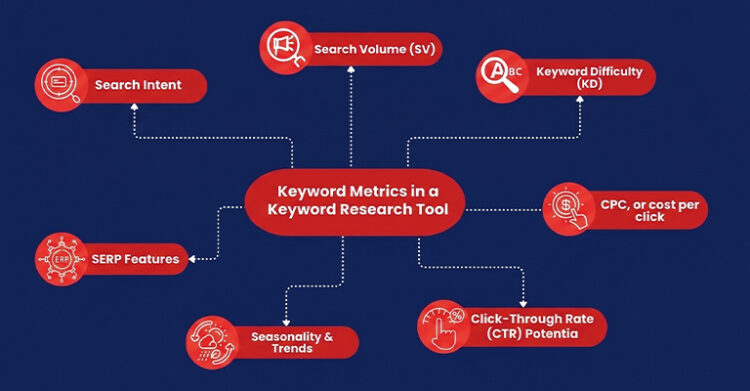
Keyword tools report dozens of numbers. Only a handful carry real weight for beginners. Learn these, and you can ignore the rest at first.
| Metric | What it tells you |
| Search volume | The estimated monthly searches for a term, which you should treat as an approximate range instead of a fact. |
| Keyword difficulty | A score from 0 to 100 estimating competition. Every tool works it out differently. |
| Search intent | The real goal behind a search. This matters most of all, though no tool measures it perfectly. |
| Business relevance | How closely a term connects to whatever you sell, because popular but irrelevant terms waste effort without return. |
| Cost per click (CPC) | The average amount advertisers pay for one click on that term, which is a useful proxy for commercial value. |
Search volume attracts the most attention while deserving the least trust. Two respected tools will report different figures for the same phrase because each estimates it from different data.
A difficulty score only means something next to your site’s authority. Authority is the level of trust your site has earned with search engines. As a rough guide, scores under 20 are suitable for new sites. Scores above 80 are major brand territory.
Cost per click is worth a glance too because advertisers rarely bid on terms that never lead to sales. Business relevance is the metric beginners most commonly forget. Ask whether someone searching that phrase could ever become a customer.
How Search Intent Changes Which Keywords You Pick
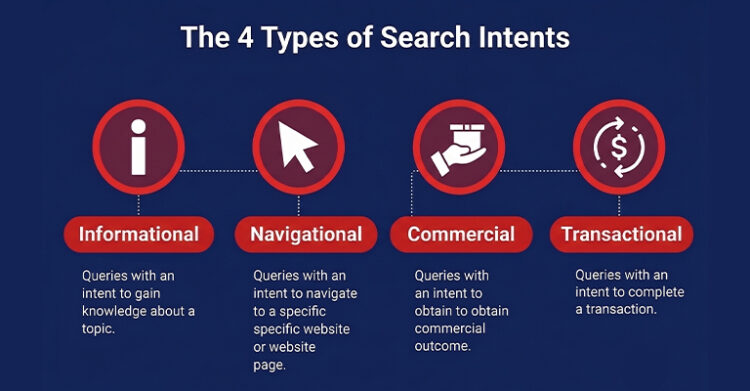
Search intent describes the real reason behind a query. Two people can search for remarkably similar words yet want different outcomes from the results. Matching intent therefore separates pages that rank from pages that never get found.
Search engines have already determined the intent behind each query. You can read that decision by examining which pages occupy the first page of results (Moz).
| Intent type | What the searcher wants and what you should publish |
| Informational | The searcher wants to understand something, so publish a guide, an explainer, or a detailed tutorial that answers their question. |
| Navigational | The searcher wants one particular website, so these terms are rarely worth targeting unless the brand is yours. |
| Commercial | The searcher is actively comparing available options, so publish a comparison, roundup, or detailed review. |
| Transactional | The searcher is ready to act now. Publish a product page, service page, or pricing page. |
The check takes about two minutes. Search your target phrase and study the first ten results. If every result is a comparison list post, a product page will struggle.
Intent also shifts over time and varies by location. Accurately reading user search intent is an ongoing habit, not a one-time check (Backlinko).
How to Do SEO Keyword Research: Step by Step
This workflow works the same with free tools or paid platforms. Run it once per topic area, then repeat every quarter.
- List five to ten broad seed terms in plain customer language, avoiding internal jargon.
- Feed each seed through a keyword tool and export every suggestion it returns.
- Mine the results page, collecting People Also Ask questions, related searches, and the suggestions Google shows as you type.
- Study two or three competing websites through a keyword tool, noting which terms bring them unpaid search visits.
- Filter by volume and difficulty, removing terms without measurable demand and terms sitting far above your current authority.
- Search every remaining term and check the dominant format of the top results.
- Score business relevance for each term as high, medium, or low, based on closeness to whatever you sell.
- Group the remaining terms into clusters that share intent and fit one page.
- Prioritize and schedule your clusters, publishing the low-difficulty and high-relevance groups first.
Step six is the stage most beginners skip. Skipping it causes the majority of expensive rewrites. A page that misreads intent rarely recovers through content optimization alone.
How to Decide Which Keywords to Target

A few fixed rules make a large keyword list easier to filter. Apply them in sequence.
- If a keyword carries volume but no business relevance, then cut it, because traffic that cannot convert costs you time.
- Keywords with strong relevance but difficulty above your authority are worth revisiting in six months.
- When the top ten results are all major brands, pick a narrower long-tail variation instead.
- If two keywords share identical intent and would receive the same answer, then target both with a single page.
- Leave out any keyword whose intent stays unclear after you examine the results.
- If a term is a question and Google shows a question box, then answer it in 40 to 60 words.
Newer websites should look for one specific combination. Low difficulty, clear intent, and high business relevance will outperform raw search volume throughout your first publishing year.
Maintain a parking list for terms you cannot win yet. Authority accumulates gradually, and phrases that appear impossible today often become possible later. Reviewing that parking list is part of your quarterly cycle.
How to Group Keywords Into Topic Clusters
A topic cluster is a group of related pages built around one central page. That central page is the pillar. The supporting pages around it are spokes.
Clustering works because a single page can rank for many different phrases at once. Search engines understand synonyms and related concepts. Separate pages targeting near-identical terms compete against each other.
Grouping decisions rest on intent, not on which words the phrases share. Two phrases belong together whenever the same thorough page would satisfy both searchers who typed them.
The most reliable grouping test is overlap in the results. If the same pages rank for two keywords, one page can usually serve both (Semrush). A similar idea appears as a parent topic, a label for the broader keyword behind a shared ranking page (Ahrefs).
- Sort your filtered keyword list alphabetically and scan for concepts that repeat across multiple entries.
- Bundle every term that one page could answer.
- Name each bundle using its broadest term, which then becomes the target keyword for your pillar page.
- Assign remaining terms in each bundle to spoke pages or to sections within the pillar itself.
- Link every spoke to its pillar, and the pillar to each spoke.
An example makes this clearer. The terms keyword difficulty, search volume, and keyword metrics all belong together on one page. Long-tail keywords and question keywords each deserve their own separate spoke pages.
How AI Search Is Changing Keyword Research

AI Overviews are the AI-generated summaries Google places above normal results. They have changed how results appear, but the core job remains unchanged. You still need to understand exactly what your audience asks.
Two shifts matter for your keyword list. The first is that queries are getting longer and more conversational, which makes question-shaped keywords more valuable.
The second is that demand keeps refreshing. Google has said for years that roughly 15% of daily searches are entirely new (Search Engine Journal). Google has since reaffirmed that figure, noting it held steady even as AI search grew. No historical keyword database can cover those queries.
The practical response is simple. Keep answering questions directly, keep your clusters tight, and see the tool workflows covered in AI keyword research.
How Query Fan-Out Changes Keyword Research
AI search engines rarely run your question as a single search. Google’s documentation confirms that AI Overviews and AI Mode may use a query fan-out technique (Google Search Central). AI Mode is Google’s chat-style search. The system issues several related searches across subtopics and then combines the results into a single answer.
Counts vary by platform and by how vague the question is. Analyses of Google AI Mode put the typical range at roughly five to eleven sub-queries (Ahrefs).
The same process also surfaces a wider range of supporting links than a classic results page (Search Engine Land).
The shift for you is from single phrases to full topic coverage. A page answering only the headline question competes on one branch of the fan-out. Cover the follow-up questions too, and you give that page more ways to be found.
Google cautions against building separate pages for every query variation, fan-out queries included (Google Search Central). Cover subtopics inside strong pages instead of splintering them across many shallow ones.
Evidence on deliberate fan-out optimization is early and mixed. One experiment revised four articles and saw citations rise from 2 to 5, while overall visibility fell (Semrush).
- Answer the obvious follow-up questions on the same page, not on separate shallow pages.
- Put a direct answer right under each heading, then expand on it.
- Write headings as questions your readers would type or ask aloud.
Common SEO Keyword Research Mistakes

Chasing search volume alone
High-volume head terms attract beginners and rarely reward them. Established sites with deep authority usually dominate a phrase drawing 50,000 monthly searches. Start narrow and build upward.
Ignoring search intent
Targeting a phrase without checking the results page first is the most expensive mistake on this list. If the top results are all comparison posts, your service page will not displace them.
Building one page per keyword
Near-identical keywords do not require separate pages. Splitting them produces shallow pages and forces your own pages into direct competition, so cluster related terms together instead.
Repeating the keyword too often
Forcing a phrase into every paragraph reads badly and violates published search engine guidance (Google Search Central). Write naturally and use variations.
Treating the list as finished
Search demand shifts alongside seasons, news cycles, and product launches. A list built once and never revisited becomes stale within a year, so schedule a regular quarterly review.
Overlooking the data you already own
Search Console shows which terms your pages already rank for, including those that are stuck on page 2. Those positions represent your cheapest available wins, and most beginners never think to look there.
SEO Keyword Research Tools Worth Using

You do not need paid software to begin this work. Free tools are enough for a first keyword list. Paid platforms mainly buy you speed and visibility into competitors.
| Tool | What it does and who it suits |
| Google Keyword Planner | Free with an ads account, supplying volume ranges and related terms, making it ideal for building a first list. |
| Google Search Console | Free, showing which queries your site already ranks for, which is the fastest source of realistic targets. |
| Google Trends | Free, showing how interest changes over time and by region, which helps with seasonal topics. |
| Google autocomplete | Free, revealing genuine phrasing as you type, making it a quick source of long-tail and question ideas. |
| Ahrefs | Paid, offering strong difficulty scoring alongside competitor keyword data, which suits regular publishers. |
| Semrush | Paid, providing a broad keyword database with intent labels and clustering features for busy multi-channel marketers. |
| Moz Keyword Explorer | Paid with a limited free tier, delivering clear difficulty and priority scoring through a beginner-friendly interface. |
Begin with two free tools working together. Keyword Planner supplies the raw ideas (Google Keyword Planner), and Search Console shows what you already rank for. A paid tool adds contextual difficulty once you outgrow free data (e.g., Semrush).
Whichever tool you select, follow Google’s own guidance on writing for people first (Google Search Central).
Your SEO Keyword Research Checklist
Work through this checklist for every topic area you intend to cover. It condenses the entire process into a repeatable sequence.
| Task | |
| ☐ | Write down five to ten broad seed terms in plain customer language, avoiding internal jargon. |
| ☐ | Export several hundred raw keyword ideas from at least one keyword research tool. |
| ☐ | Collect People Also Ask questions and related searches for each of your seed terms. |
| ☐ | Review the terms bringing unpaid search visits to two or three competing websites. |
| ☐ | Remove every term showing no measurable search volume in your chosen tool. |
| ☐ | Drop terms above the authority your site commands today. |
| ☐ | Search each remaining term and match your planned format to the dominant result type. |
| ☐ | Mark every remaining term as high, medium, or low for business fit. |
| ☐ | Group together all terms that could be covered on a single full page. |
| ☐ | Order your clusters by difficulty and assign realistic publication dates to each. |
| ☐ | Set a calendar reminder to repeat this entire process in three months. |
Pair this checklist with a broader SEO checklist once you move into publishing. The linked SEO glossary defines any unfamiliar terms.
Putting Your Keyword Research to Work
SEO keyword research is a habit, not a one-time project. It keeps your publishing tied to real demand instead of guesswork.
The core method is simple. Find the phrases your audience uses and check whether you can compete with them. Then confirm what those searchers expect and group your targets sensibly.
Start here: open Search Console and export every query ranking between positions 11 and 20. Those pages need small improvements, not new content.
From there, strengthen the pages you keep with sharper blog titles and a steady quarterly review cycle. If specific questions remain, the collected keyword research questions cover the finer details.
Additional Resources
People Also Ask About SEO Keyword Research
How many keywords should one page target?
Target one primary keyword plus a few close variations. A well-written page ranks for dozens of connected phrases on its own.
Is keyword research still relevant with AI search?
Yes, because AI systems still surface content matching what people ask. Understanding the language your audience uses remains the foundation of that match, regardless of the tool they use.
How long does keyword research take?
A first pass for a small site takes two to four hours. Quarterly reviews take under an hour once your list is in place.
Can I do keyword research without paid tools?
Yes, because Keyword Planner, Search Console, Trends, and autocomplete cover every beginner need. Paid platforms mainly add competitor data and faster difficulty scoring.
What is a good keyword difficulty score to target?
No universal number exists because difficulty is relative to your site authority. Newer sites usually succeed below 20. Established sites reach far higher.
Frequently Asked Questions
What is SEO keyword research?
SEO keyword research means finding the search terms your audience uses and judging which ones you can win. You collect keyword ideas, measure both demand and competition, then confirm what real searchers expect to find. The output is a ranked list of the terms your own website can realistically compete for today. That ranked list then sets which pages you create and the order in which you publish them.
How do I start keyword research as a complete beginner?
Begin by writing down five to ten plain-language terms that describe whatever you sell or offer to customers. Feed those seed terms into Google Keyword Planner and export every keyword suggestion the tool returns. Then search several of those phrases yourself and study which pages already hold the top positions. That mix of tool data and manual checking gives you a usable first list of keywords without paid software.
What is the difference between a keyword and a search query?
A search query is the exact text somebody types into a search engine when looking for something. A keyword is the specific term you deliberately choose to optimize one particular page around for search. The two often match, though a single page usually ranks for dozens of queries beyond its chosen keyword. Marketers use both words in the same way every day, and the difference rarely affects your daily workflow.
How much search volume is enough to target a keyword?
No single fixed threshold exists because search volume matters far less than the combined impact of relevance and competition. A term drawing only 50 monthly searches can be worth targeting when those searchers are ready to buy. A term drawing 20,000 searches can be worthless if it never leads to anything useful for your business. Judge every phrase on business fit first, and only then on whether you could actually rank for it.
What is keyword difficulty and how accurate is it?
Keyword difficulty is a score estimating how hard ranking will be, usually on a 0 to 100 scale. Every tool works differently, mostly depending on how many other sites link to the pages already ranking well. Treat it as a rough comparison within one single tool, and never as an absolute or portable measure. Your own website authority changes what any given difficulty score really means for you in daily practice.
Should I target long-tail or short-tail keywords?
Newer and smaller websites should weight their keyword lists heavily toward long-tail keywords from the very start. These longer phrases attract fewer monthly searches and face far less competition from big, established sites. They also carry much clearer intent, so the visitors they attract tend to convert at higher rates. Move slowly toward shorter head terms as your website builds authority and steadily earns quality links over time.
How often should I redo my keyword research?
A full keyword review every three months suits most smaller websites and independent blogs very well indeed. Search demand shifts with the seasons, product cycles, and news events, so a static list slowly loses accuracy. Between those quarterly reviews, check Search Console every month for new queries your pages have started attracting. Those emerging terms often reveal valuable chances that your original keyword research had missed the first time around.
Can two pages on my site target the same keyword?
You should avoid this, because your own pages will then compete against each other for identical positions. The problem is called keyword cannibalization, and it splits the ranking signals you have worked to build. If two existing pages already overlap heavily, merge them into one stronger page or separate their focus. Keeping one target keyword per page maintains a clean and stable structure across your whole website over time.
Do keyword research tools give accurate search volumes?
Search volume figures are estimates rather than measured counts, so two different tools will report different numbers. Each platform builds its estimate from a different data sample, so the gaps between tools can be surprisingly wide. Use search volume only to compare candidate terms against each other within one single consistent tool. Never treat any single reported figure as a precise forecast of your own future organic search traffic.
What is query fan-out in AI search?
Query fan-out is when an AI search system quietly breaks your single question into several related searches. Google confirms that both AI Overviews and AI Mode may use this technique across subtopics and data sources. The practical effect is that one page can be pulled into answers for questions that nobody actually typed. Covering a whole topic properly now matters more than matching any single phrase exactly in your content.
How do I find keywords my competitors rank for?
Enter a competitor’s domain into a paid keyword research platform such as Ahrefs, Semrush, or Moz. Open its organic keywords report, which lists every term sending them traffic along with its estimated monthly volumes. Look carefully for phrases where their current ranking page appears weak, shallow, or clearly outdated to readers. Those gaps usually represent your most realistic opportunities to publish a stronger, more competitive page.
Glossary of Key Terms
| Term | Definition |
| Keyword | A word or phrase people enter into a search engine, which you then optimize a page to match. |
| Seed keyword | A broad starting term you feed into a research tool to generate a much larger list of ideas. |
| Long-tail keyword | A specific phrase of three or more words carrying lower search volume and much lower competition. |
| Query fan-out | The technique where an AI search system issues several related searches across subtopics before answering. |
| Search volume | The estimated number of times a keyword is searched per month, usually reported as a range. |
| Keyword difficulty | A tool-generated score estimating how hard ranking on the first page for a particular term would be. |
| Search intent | The real goal behind a query, such as learning something, comparing options, navigating, or making a purchase. |
| Head term | A short, broad keyword with high search volume and heavy competition from well-established sites. |
| Topic cluster | A group of related pages built around a central pillar page that covers a broad subject area. |
| Pillar page | The central page within a cluster, covering a broad topic and linking outward to supporting spoke pages. |
| Keyword cannibalization | The problem arises when two pages on the same website target the same term and compete against each other. |
| Keyword stuffing | The practice of repeating a term unnaturally often, which search engines identify and treat as spam. |