Quick Answer
The future of search marketing revolves around a shift from climbing the rankings to earning visibility inside AI answers. Google now shows AI-written answers at the top of results, while ChatGPT and Perplexity field more queries. Your job as a digital marketer is no longer about chasing clicks, but becoming a source that AI systems cite and trust.
Key Takeaways
- AI answers now top many searches, so fewer people click through to sites.
- Google still leads search, but its share slips as AI tools grab a slice of queries.
- Zero-click behavior keeps rising, so visibility matters even when no one visits your page.
- Generative engine optimization, shaping pages so AI tools quote them, gets your content into AI answers.
- Agentic search lets AI assistants research and buy for users, adding a new gatekeeper.
- Strong brand authority and clear, structured content protect you best against these shifts.
Table of Contents
Why Search Marketing Feels Different Now
Search felt stable for years, which made planning simple. You identified keywords, wrote a helpful page, earned links, and waited to rank.
That familiar playbook is shifting beneath you. AI-generated answers greet users before the classic blue links, and many searches end without a click. For a small team, this feels less like an update to their routine and more like a wispy moving target.
This guide explains the future of search marketing in practical terms. You’ll learn about what’s changing, why these changes matter, and how to keep your brand visible. You can expect a grounded look at where search is heading, without the jargon or hype.
What Is the Future of Search Marketing?
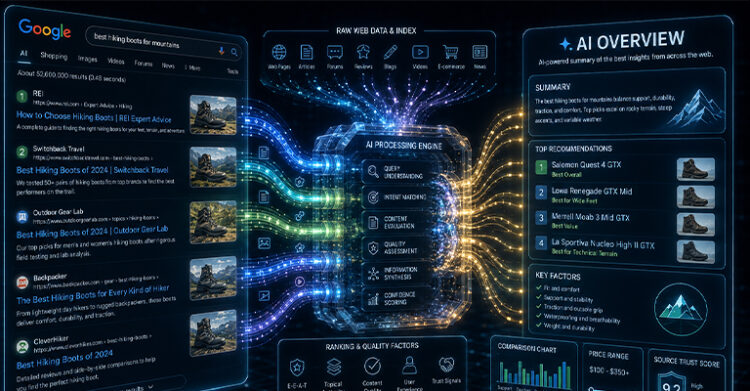
Traditional search sent users to a ranked list of pages, whereas AI search answers questions directly and cites a handful of trusted sources.
Classic search engine optimization, or SEO, remains the base of this work. SEO helps your content rank in the SERPs. What changes is where your content is visible and how you earn this prime real estate.
Two Google features are driving this shift: AI Overviews and AI Mode. AI Overviews are AI-written summaries that appear above most SERPs, and AI Mode is a conversational search experience powered by Google’s Gemini model. Both run on the same ranking system, so quality content still wins (Google).
Due to this shift, you now need to optimize for two goals at once: ranking well and becoming the answer an AI system repeats.
How Search Behavior Is Changing Right Now
Three shifts are already visible in how people search. Knowing how AI search engines work makes each easier to follow and understand.
AI Answers Replace the Blue Links
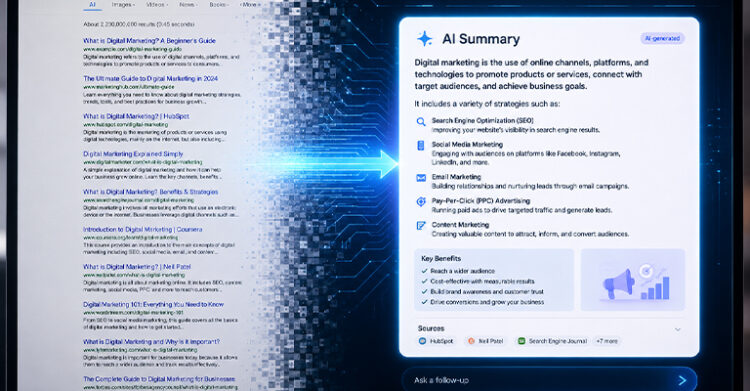
Open Google today and an AI summary often sits above the classic results. About 65% of US adults now see these AI summaries at least sometimes (Pew Research Center). Users read the summary, get their answer, and often stop there.
Summaries like these save searchers time and let your page shape a decision without a visit. Getting cited in an AI answer builds trust and recognition, but it doesn’t drive traffic to your site. Furthermore, your content must be well-structured and clear for an AI system to quote accurately.
Zero-Click Search Keeps Growing
A zero-click search ends without the user visiting a website. AI answers push that share higher, since the answer sits right on the results page. When an AI Overview appears, clicks to the top result fall about 58% (Ahrefs).
For your business, this redefines success: a visit is no longer the only win. Being named in the answer still carries value, even when no click follows. You now measure two new vague metrics: influence and awareness, not just raw traffic.
The Search Landscape is Fragmenting
Google is no longer the only place your audience searches. Many users now ask ChatGPT, Perplexity, or Gemini for recommendations, and younger searchers often start on TikTok or YouTube.
Google still handles about 90% of searches worldwide, though its lead narrows as these options mature (Statcounter). Your audience is spreading across more places, so a single-channel plan leaves visibility on the table.
Key Forces Shaping the Future of Search Marketing
Several forces steer this shift. Understanding them helps you plan instead of react.
Generative Engine Optimization
Generative engine optimization, or GEO, is the practice of shaping content so AI systems cite it. It builds on classic SEO instead of replacing it. Clear structure, direct answers, and credible sources help AI models pick your page.
Picture two readers for every page you publish. A human searcher wants a quick, useful answer, while an AI model wants a source it can trust and quote. Content that serves both earns the citation.
Certain edits can increase a page’s visibility in AI search results by up to 40% (Princeton study). Adding statistics, quotes, and reputable citations helps the most.
Agentic Search and AI Shopping

Agentic search puts an AI assistant in charge of the task. Instead of showing links, the assistant researches options and can complete a purchase. New payment and shopping systems now allow agents to buy on users’ behalf.
This puts a gatekeeper between you and the customer, since the agent picks which brands to recommend. To stay in the running, your product data and reputation must be easy for machines to read and verify.
Entity Authority and Brand Mentions
AI systems favor brands they understand and see cited often, which is why entity authority matters. An entity is a clearly defined thing, like your company, that search systems recognize and link to topics.
You build this authority through steady mentions across trusted sites. Reviews, directories, and reference sites reinforce who you are. These signals reflect Google’s focus on experience, expertise, authoritativeness, and trust. The stronger your reputation, the more likely an AI answer names you.
Conversational and Multimodal Search
People increasingly search by talking, not typing, asking full questions and expecting a natural reply. A growing share of queries now use voice or images instead of text, a shift called multimodal search. Google Lens, a tool for image-based search, is one example. It alone handles close to 20 billion visual searches a month, many of which have shopping intent (Google).
This developing trend rewards a natural, question-and-answer style. Matching search intent, the reason behind a query, matters more than ever. Write the way your audience speaks, and cover the follow-up questions that would surface in an organic conversation.
How to Prepare for the Future of Search Marketing

You can’t control how AI evolves, but you can control the readiness of your content. These steps keep your search marketing strong through the change.
- Audit the sources of your traffic. Check which pages, keywords, and channels drive results today. This sets a baseline before you change anything.
- Answer real questions clearly. Lead each page with a direct answer, then add depth below it. This format suits both readers and AI systems.
- Strengthen your brand signals. Earn mentions on trusted sites, keep your details consistent, and collect real reviews.
- Add structure to your content. Use clear headings, short sections, and structured data so machines can read and better understand your content.
- Track more than clicks. In addition to traffic, monitor brand mentions, AI citations, and assisted conversions (the sales that AI helped influence).
- Keep publishing helpful content. A steady AI content strategy builds the authority AI systems reward over time.
Staying Visible as Search Evolves
The future of search marketing rewards brands that continually prove useful and trusted. The channels are shifting, but the core goal hasn’t changed. Help your audience, and make that help easy for AI to find and quote.
None of this asks you to start over. The SEO-based work that earned rankings still counts because AI systems reward the same signals of quality and trust. They simply apply them in new places, from AI Overviews to chat assistants. Lastly, master the fundamentals, and you can win each new format as it arrives.
You don’t need to chase every trend at once. A solid base in AI search engine optimization makes these shifts easier to handle. Pick one small step and start this week.
The brands that adapt early build an edge that compounds. Every helpful page you publish now strengthens your reputation with both readers and AI. Search will continue to change, yet useful, trustworthy content stays the constant. Small, steady moves keep you visible as search keeps evolving.
Additional Resources
Common Mistakes to Avoid
Ignoring AI Search Entirely
Some marketers dismiss AI search as hype and keep the old playbook, yet they fall behind as adoption grows. Start small, but start now.
Chasing Clicks Only
Judging success by traffic alone misses the bigger picture. Many wins now happen inside the answer, with no visit. Measure visibility and mentions too.
Writing for Machines Instead of People
Stuffing pages with keywords backfires, since AI systems and readers both prefer clear, genuine help. In testing, keyword stuffing lowered a page’s visibility in AI answers (Princeton study). Write for a person first, then format for easy reading.
Neglecting Brand Authority
Shallow, anonymous content struggles to earn AI citations. Without trust signals, systems have little reason to name you. Invest in your reputation as much as your pages.
Tools and Resources
A few tool types help you track visibility across both classic and AI search.
| Tool type | How it helps |
| Google Search Console | Shows how your pages perform in Google, including views and clicks. |
| AI visibility trackers | Monitor whether AI answers mention or cite your brand. |
| SEO suites like Ahrefs | Track keywords, links from other sites, and AI Overview presence in one place. |
| Structured data validators | Check that your structured data is readable by search systems. |
| Analytics platforms | Measure assisted conversions and the visits AI tools send you. |
Your Search Marketing Action Plan
Use this checklist to turn the ideas above into steady progress.
| Task | |
|---|---|
| ☐ | Audit your current traffic sources and top pages. |
| ☐ | Add a clear, direct answer near the top of each key page. |
| ☐ | Build structured data into your important pages. |
| ☐ | Earn brand mentions on trusted, relevant sites. |
| ☐ | Track AI citations and mentions, not just clicks. |
| ☐ | Publish helpful content on a steady schedule. |
People Also Ask
Is SEO dead?
No, SEO isn’t dead, but it’s changing. AI search relies on the same quality signals good SEO builds. Strong content and authority now feed both traditional rankings and AI answers.
Will AI replace search engines?
AI is reshaping search engines more than replacing them. Google is folding AI into its results instead of shutting them down. Expect a blend of classic links and AI answers for years.
What is generative engine optimization?
Generative engine optimization, or GEO, is the practice of shaping content so AI systems cite it. It uses clear structure and credible sourcing to earn a place in AI answers.
How do I show up in AI Overviews?
To optimize content for AI Overviews, answer common questions clearly and back your claims with credible sources. Use clean headings and structured data so AI can read your page. Build brand authority so systems trust your content.
Does traditional search still matter?
Yes, traditional search still drives most discovery. Google handles the largest share of queries by far. Optimizing for classic and AI search together gives the widest reach.
Frequently Asked Questions
What does the future of search marketing look like?
The future of search marketing blends traditional links with AI-generated answers. People will find brands through AI Overviews, chat assistants, and voice search, not only through ranked pages. Your focus shifts from earning clicks to becoming a source that AI systems trust and cite. Classic SEO still matters since AI relies on similar quality signals. Brands that stay helpful and easy to read will keep their visibility as search keeps evolving.
Is search marketing still worth it in 2026?
Yes, search marketing is still worth it, and arguably more valuable now. Billions of searches happen every day across Google and AI tools. Being visible where your audience looks remains one of the best ways to earn trust and demand. The tactics are shifting toward AI answers and brand authority, but the payoff holds. A small, consistent effort can still bring steady, qualified traffic and mentions over time.
How is AI changing SEO?
AI is changing SEO by moving answers to the top of results. AI Overviews summarize information directly, so fewer users click through to sites. Search systems now favor content that’s clear, credible, and easy to quote. Brand authority and structured data carry more weight than before. The core skills of good SEO still apply. You now optimize to be cited inside AI answers, not just to rank.
What is answer engine optimization?
Answer engine optimization, or AEO, is the practice of formatting content to win direct answers. It targets featured snippets, the boxed answers at the top of Google, along with AI Overviews and voice results. You focus on concise, well-structured answers to common questions. AEO overlaps with SEO but leans harder on clarity and format. As AI answers spread, AEO becomes key to staying visible in modern search.
Do keywords still matter for search?
Yes, keywords still matter, but their role has softened. Search systems now read for meaning and intent, not exact phrases. You should still research the questions and terms your audience uses. That research guides the topics you cover and the answers you give. Focus on matching real intent. AI systems reward content that fully resolves a query, more so than pages that simply repeat a target keyword.
How do I optimize content for AI search?
Start by answering the main question near the top of the page in plain language. Add clear headings, short sections, and structured data so systems can read your content. Support claims with credible sources to build trust. Cover related follow-up questions the way a real conversation would. Finally, strengthen your brand authority through mentions and reviews. AI systems favor sources they recognize and see cited across the web.
Which AI search platforms matter most?
Google remains the most important platform since it still handles the majority of searches. Its AI Overviews and AI Mode reach a huge audience daily. Beyond Google, ChatGPT and Perplexity are growing fast as answer engines. Microsoft Copilot and Gemini add more places to watch. The right mix depends on where your specific audience spends time. So check your analytics before you spread your effort too thin.
How do I measure success in AI search?
Look beyond clicks and rankings to a fuller picture of visibility. Track how often AI answers mention or cite your brand. Watch the visits AI tools send you in your analytics. See if searches for your brand name rise, which often happens when people spot you in AI answers. Assisted conversions also reveal influence that a single click misses. Together, these signals show whether your brand is winning attention as search changes.
Is traditional SEO still worth learning?
Yes, traditional SEO is still worth learning, and it remains a strong foundation. AI search runs on many of the same signals, like relevance, quality, and authority. Understanding SEO helps you grasp why AI systems pick certain sources. It also keeps you visible in classic search, which still drives most traffic. Learn SEO first, then layer AI-focused tactics on top as your confidence and results steadily grow.
Will agentic search change how customers buy?
Yes, agentic search is starting to change the buying journey. AI assistants can now research options and complete some purchases on a user’s behalf. That effectively adds a new decision-maker between your brand and the customer. To stay in consideration, your product details, pricing, and reviews must be clear and machine-readable. Brands with strong reputations and accurate data will have the best odds of being recommended by these assistants.
Glossary
| Term | Definition |
| AI Overviews | Google’s AI-written summaries that appear at the top of many search results. |
| AI Mode | Google’s conversational search experience that answers questions through a chat-style interface. |
| Zero-click search | A search that ends on the results page without the user visiting any website. |
| Generative engine optimization (GEO) | The practice of shaping content so AI systems quote and cite it. |
| Answer engine optimization (AEO) | The practice of formatting content to win direct answers like snippets and AI results. |
| Agentic search | Search where an AI assistant researches and can act on a task for the user. |
| Entity authority | The trust a brand earns by being clearly defined and cited across reputable sources. |
| Structured data | Code added to a page that helps search systems understand its content. |