

Google will rank AI-written content, but human-led content wins most top spots. Ahrefs found no Google penalty for pages that use AI, yet Semrush found that people wrote about 80% of #1 results. For AI and human writing SEO, a hybrid approach makes the most practical long-term choice. Use AI to speed up research and drafts, then apply your own experience and judgment to the final version.
Key Takeaways
- Google ranks content on helpfulness and quality, regardless of who or what wrote it.
- Ahrefs found no Google penalty for AI use, though AI-heavy pages often performed worse.
- Human writers produced about 80% of #1 results in a Semrush study of 42,000 blog posts.
- Smaller side-by-side tests found that human pages ranked higher and drew more traffic.
- Google indexes AI-heavy pages less often, and those pages earn fewer search impressions.
- Google now calls fact-checking all AI-generated content critical before publishing.
- A hybrid AI and human writing workflow combines the speed of AI with the human judgment that builds lasting trust.
Table of Contents
You’ve probably wondered whether AI can write your blog posts and still rank in Google. AI tools produce drafts in minutes, and you need to publish on a steady schedule. But you also worry Google will bury anything that reads as if a machine wrote it.
You no longer have to guess about AI and human writing SEO performance. Recent studies tracked it across hundreds of thousands of pages, and their results cut through the online debate. They point to a practical middle path that fits a small team.
This post builds on a broader AI content strategy framework and answers one question that affects your rankings. You’ll see how Google treats AI content and what the ranking data shows. You’ll also get a content brief template, a six-step workflow, and a method for tracking results over time.
What AI and Human Writing Means for SEO
Before you compare results, learn the three main ways teams create content today.
AI-Generated Content
AI-generated content is text that a tool like ChatGPT, Claude, or Gemini produces with little or no human editing. A person writes the prompt, but the tool supplies the wording and most of the claims. This content comes together fast and costs little, but it often sounds generic and can include confident errors.
AI-Assisted Content

AI-assisted content is writing where a person stays in charge and assigns AI specific tasks, such as outlines, research summaries, or rough first drafts. The person then edits the draft, fact-checks it, and adds real experience. Many marketers work this way, and this guide recommends it for long-term results.
Human-Written Content
Human-written content is text that a person researches, writes, and edits without generative AI. It often includes original stories and first-hand details that no tool can honestly invent. Strong posts take several hours to write, though, which makes frequent publishing hard for a small team.
How Google Treats AI-Generated Content
Since early 2023, Google has rewarded helpful AI and human content alike, no matter how you produce it. Using automation mainly to manipulate rankings violates its spam policies, while using AI to create helpful content does not (Google Helpful Content Guide).
The Fact-Check Rule You Need to Know
In October 2026, Google updated its generative AI guidance with a direct instruction for site owners. It now calls manual fact-checking and review of all AI-generated content critical before publishing (Google Search Central). That review extends beyond body copy to titles, meta descriptions, image alt text, and schema markup since all of them can appear in search results.
What Counts as Scaled Content Abuse
Google’s spam policy on scaled content abuse can apply when you use AI to mass-produce pages that add no value for users (Google Search Central). Google judges the pages themselves, regardless of who produced them. A site that publishes hundreds of thin AI pages faces the same risk as a site that pays writers to produce those pages by hand.
What the Ranking Data Shows for AI and Human Writing SEO
Several research teams have measured how AI and human writing perform through large studies of live search results and smaller side-by-side tests. The large studies used AI detection software to estimate how much of each page AI wrote, then compared those estimates with Google rankings.
The Ahrefs Studies
SEO software company Ahrefs analyzed 600,000 pages ranking in the top 20 for 100,000 keywords (Ahrefs Ranking Study). It found almost no connection between a page’s share of AI text and its rank. About 86.5% of those pages contained some AI content, 4.6% were fully AI-generated, and 13.5% were fully human.
A 2026 Ahrefs study of 331,000 pages looked beyond rank position (Ahrefs Indexation Study). It checked indexation, meaning whether Google stores a page so it can appear in search. It also tracked impressions, meaning how often a page shows up in results. AI-heavy pages fell behind on both. About 49% of low-AI pages made it into Google’s index, compared with about 40% of very-high-AI pages, and low-AI pages earned two to three times more impressions. Pages with less than 50% AI content also held 82.2% of top-three spots. Ahrefs concluded that Google punishes low-quality content, which often overlaps with heavy AI use.
The Semrush Study
Semrush, another major SEO platform, studied 42,000 blog posts ranking for 20,000 keywords (Semrush). Human-written pages held about 80% of #1 positions, AI-generated pages held roughly 10%, and mixed content made up most of the rest. By Semrush’s math, human content was about eight times more likely to rank first. From position four down, human and AI pages appeared at much closer rates.
The Reboot Online Experiment
SEO agency Reboot Online ran a controlled test in 2023 across 10 new websites with no backlinks (Reboot Online). Five sites published human-written articles, and five published GPT-4 articles. All ten targeted a made-up keyword, so no outside sites competed. The human sites averaged position 4.4, and the AI sites averaged 6.6 (lower is better). The test used a small sample and an older AI model, and it left out human-edited AI content.
The NP Digital Traffic Test
In a 2024 test, marketing agency NP Digital compared 744 articles across 68 websites. Its in-house team wrote some, and ChatGPT wrote the rest (NP Digital). After five months, the human articles drew 5.44 times more monthly traffic. ChatGPT needed about 16 minutes per article, and the human writers needed 69. Even after accounting for that extra time, human writing earned more visitors per minute of work (4.10 versus 3.25).
How to Read These Numbers
The table below lines up the AI and human writing data from all four research teams.
| Finding | Heavy AI Content | Low-AI or Human Content |
| Share of #1 rankings (Semrush) | About 10% | About 80% |
| Share of top-three spots (Ahrefs) | About 9% (pages with 80%+ AI text) | 82.2% (pages with under 50% AI text) |
| Pages indexed by Google (Ahrefs) | About 40% | About 49% |
| Search impressions (Ahrefs) | Lower, but no sudden drop | Two to three times higher |
| Average rank in a controlled test (Reboot Online) | 6.6 | 4.4 (lower is better) |
| Monthly traffic after five months (NP Digital) | Starting point | 5.44 times higher |
Keep a few limits in mind when you read AI and human writing SEO studies. They show patterns, not proof of cause, and the researchers acknowledge that AI detectors make mistakes. Detectors judge finished text, so a page labeled human may still have involved AI. The large studies also include only pages that already rank, which hides the pages that never did. Still, the newest data is consistent. Unedited, AI-heavy pages rank lower, earn less traffic, and appear in Google’s index less often, even though Google doesn’t penalize AI use itself.
Why Human-Led Pages Win the Top Spots
Human pages hold most #1 spots in AI and human content studies, even without an AI penalty. Trust explains much of that gap. Google’s E-E-A-T framework stands for experience, expertise, authoritativeness, and trust. Google calls trust the most important part, with the other three feeding into it (Google Helpful Content Guide). The framework describes the qualities Google’s systems aim to reward, though Google doesn’t treat it as a direct ranking factor.
AI tools predict likely words from what already exists online, so their writing echoes what’s already published. Human writers add what the web lacks:
- First-hand experience: results from your own campaigns, client work, or tests.
- Original data: survey numbers, screenshots, or before-and-after metrics you collected.
- Clear opinions: points of view that tell readers what to do and why.
- Verified details: facts you checked against original sources.
Google also warns that made-up author names and AI-generated headshots signal a low-quality page. A real byline backed by real credentials earns reader trust. That mix of experience and accountability also helps AI-proof content hold its value as search changes.
AI and Human Writing SEO Over the Long Term

In AI and human writing SEO, short-term wins don’t guarantee long-term results. A fast AI draft can reach page two within weeks, but holding position one for a year takes more than speed. The table below compares how each approach typically performs over time.
| Factor | AI-Generated (Little Editing) | AI-Assisted (Human-Led) |
| Production speed | Very fast | Fast |
| Odds of getting indexed | Lower | Higher |
| Chance at position #1 | Low | Better, especially with original data |
| Brand trust | Weak, often generic | Builds over time |
| Traffic over time | Lower and often uneven | Steadier as authority builds |
Long-term SEO now includes AI search. Answer engines, the AI tools that answer questions directly, also cite human work far more often. SEO firm Graphite found that human writers produced 82% of articles cited by ChatGPT and Perplexity (Graphite). Strong answer engine optimization gives those tools clear passages to quote. When you’re optimizing content for AI Overviews, human expertise makes those passages worth citing.
Which Content Types Suit AI Assistance
The type of content you create determines how much AI can help a post. Use this guide to decide what to hand off and what to keep in human hands.
| Content Type | How to Use AI |
| Original research and case studies | Lead the research and analysis yourself, and let AI organize your findings. |
| Product reviews and comparisons | Base them on real testing, and write first-hand experience yourself. |
| Health, money, or legal advice | Keep a qualified expert in charge, and verify every claim. |
| How-to and educational posts | Use AI for outlines and drafts, then check accuracy closely. |
| Product or service descriptions | Let AI draft from verified details, then review the output. |
| Generic posts with nothing new to add | Find a unique angle first, or skip the topic. |
Template: Your Hybrid Content Brief
After you decide how much AI help a post needs, capture your plan in a short brief. Fill one out before every post that blends AI and human writing. The brief keeps AI on support tasks and keeps you in charge of what drives rankings.
| Brief Field | What to Fill In |
| Target keyword | The main phrase plus two or three close variations |
| Search intent | What the reader wants to learn or do |
| Unique angle | One sentence on what your post adds that others miss |
| Your proof | Data, stories, or examples only you can provide |
| AI tasks | Outline, research summary, or rough first draft |
| Human tasks | Voice, examples, fact-check, and final edit |
| Sources to verify | Every stat and claim the AI suggested |
| Internal links | Three to five related posts on your site |
For example, say you run a local bakery and want to rank for “wedding cake pricing” in your city. Your unique angle could be real price ranges from your last 20 orders, a detail no AI tool has.
How to Build a Hybrid AI and Human Writing SEO Workflow
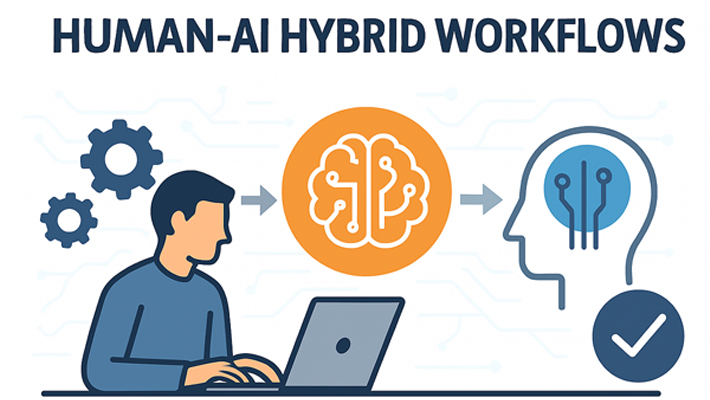
With the brief done, move into writing. AI handles the groundwork, and you make the judgment calls. Follow these six steps for each post.
Step 1: Set the Angle Yourself
Decide what the post must prove to the reader. Pick your target keyword and study the top results to spot what they miss. Write your angle in one sentence in the brief, because AI won’t find it for you.
Step 2: Gather Your Own Proof
Before you open an AI tool, collect the material only you have, such as campaign results, common client questions, screenshots, or stories from your own work. These details add substance, and competitors will struggle to copy them.
Step 3: Use AI for Research and Outlines
Next, bring in AI to speed up research and planning. Ask it to summarize sources, suggest subtopics, or outline the post from your angle. Treat every claim it gives you as a lead to verify, and save the source links for later.
Step 4: Draft With AI, Then Rewrite in Your Voice
Let AI produce a rough first draft if it saves time, then rewrite the draft section by section. Add your own examples and replace vague claims with specific details. Strong copywriting habits matter here, since clear, direct sentences keep readers on the page.
Step 5: Fact-Check Everything
Verify every statistic, quote, and claim against its original source before the post goes live. Check your title, meta description, and image alt text too, since Google now calls this review critical. One wrong number can undo months of trust with your readers.
Step 6: Optimize and Publish
Finish with on-page basics: clear headings, internal links, and short passages that answer common questions right away. A repeatable content optimization routine speeds up this step. Add a real byline and a short author bio, then publish and track the page’s performance.
How to Measure Long-Term Results

Early rankings reveal little about a post’s long-term value. To judge your AI and human writing mix fairly, compare posts at the same age and track more than position.
- Review each post at 90, 180, and 365 days after publishing.
- Compare posts that share the same search intent, format, and level of keyword competition.
- Track indexing, impressions, clicks, backlinks, and leads or sales.
- Add up writing, editing, and update time to see the real return on each post.
If you’re newer to search, these SEO best practices for beginners will help you master the basics before you publish more often.
The Bottom Line on AI and Human Writing SEO
AI-written content can rank, and Google won’t penalize it for using AI. Still, the most recent data shows that human-led content wins most top positions and earns more impressions over time.
For most small teams, the best path in AI and human writing SEO is to treat AI as an assistant. Let it speed up research and drafting, then add the experience and insight only you have. You’ll publish more consistently and protect the trust that keeps a page ranking. On your next post, start with the brief and work through the six steps. After you publish, set check-ins at 90, 180, and 365 days so your Search Console data shows what works for your audience.