

Quick Answer
AI search engines answer your question with a written paragraph instead of a list of links. The process happens in three steps. First, the AI interprets what you are asking. Second, it pulls relevant passages from across the web. Third, it writes a clear answer with sources you can verify. This pattern is called retrieval-augmented generation (RAG), which powers ChatGPT, Perplexity, and Google AI Overviews.
Key Takeaways
- AI search engines combine large language models with real-time content retrieval to answer questions directly.
- Retrieval-augmented generation, or RAG, is the core architecture behind most AI search engines today.
- Vector embeddings turn words into numbers so AI can match meaning, not just keywords.
- Content is retrieved in chunks rather than full pages, which changes how you should structure your writing.
- Citations matter more than rankings in AI search, since being cited is the new top spot.
- Google AI Overviews now reach 2.5 billion monthly users, so AI search is not a niche channel.
- Clear structure, defined entities, and direct answers help your content get retrieved by AI search engines.
Table of Contents

You type a question into ChatGPT. A few seconds later, you get a paragraph that reads as if an expert wrote it. There’s no list of blue links to sort through. Just a direct answer, with sources cited at the bottom. In May 2026, Google announced that AI Mode surpassed one billion monthly users. AI Overviews now reach 2.5 billion people each month (Google). So how does that actually happen? And what does it mean for the content you publish?
This guide breaks down how AI search engines work in plain language. You’ll learn the five steps that turn a question into a cited answer. You’ll see how vector embeddings let AI match meaning instead of words. And you’ll get a practical checklist to make your content easier for AI to find and cite.
If you’re already familiar with traditional search engine optimization, this is the next layer. Classic search engines still crawl, index, and rank. AI search engines simply add a synthesis step that changes what is served on the SERP. Pew Research found that 65 percent of U.S. adults now see AI summaries in search at least sometimes (Pew Research Center). The strategy side of this shift belongs to answer engine optimization. This post focuses on the mechanics.
What Is an AI Search Engine?
AI search engines use a large language model (LLM), to answer questions directly. Instead of returning a list of links, it generates a written answer. It pulls fresh content from the web to support that answer.
An LLM is a type of AI model trained on huge amounts of text. It learns patterns in language so it can write fluent responses. ChatGPT, Google Gemini, and Claude are all examples of LLMs.
The key shift is from retrieval to synthesis. A traditional search engine retrieves and ranks pages. AI search engines retrieve, rank, and then write. That synthesis step is what makes it feel like a conversation. It also reshapes how publishers grow their search traffic. Many readers now stop at the AI summary instead of clicking through to the source.
If a tool generates a direct answer to your question and cites sources, then it falls under the umbrella of AI search engines. If it just gives you a list of links sorted by relevance, it’s a traditional search engine. As of Q2 2026, ChatGPT has more than 900 million weekly active users, putting its monthly base above one billion. The platform processes around 2.5 billion prompts every day (First Page Sage).
How AI Search Engines Differ From Traditional Search

Traditional search and AI search both start with a query and end with an answer. What happens in between is very different. Understanding that difference helps you optimize for both.
Traditional Search at a Glance
A traditional search engine crawls the web with bots like Googlebot and builds an index. It then ranks pages based on signals such as backlinks, which are links pointing to a page from other websites. On-page content matters too. The result is a list of links. You click the link and read the page yourself.
This is the model Google built its business on. It still drives most of the web’s organic traffic today.
AI Search Adds a Synthesis Layer
AI search engines do everything a traditional engine does. However, it adds two more steps. First, it retrieves relevant passages from indexed content. Second, it feeds those passages to an LLM that writes a unified answer.
The user sees the synthesized answer first. Citations sit underneath. This shifts the goal from ranking first to being cited. AI Overviews now reach 2.5 billion people each month (Google). They trigger on roughly a quarter of Google searches, and that share keeps growing.
The Five-Step Process that Fuels AI Search Engines
Here is the core flow. AI search engines follow some version of these five steps. The names of the parts change, but the logic does not.
Step 1: Understanding the Query

When you type a question, the AI search engine first figures out what you really mean. This uses natural language processing (NLP), the field of AI focused on understanding human language. The system may rewrite your question into one or more sub-queries.
For example, take the question “What’s a good camera for hiking?” The system might split it into three sub-queries. Each one targets a different aspect: lightweight, weather-resistant, and long battery life.
Google calls this technique query fan-out. AI Mode fires multiple related searches at once and stitches the results into one synthesized answer (Google). The benefit for you: a single query can pull from many subtopics in parallel.
Step 2: Retrieving Relevant Content
Next, the system searches a content index for passages that match the sub-queries. Most engines use hybrid search, which combines two methods. Keyword search matches exact words. Vector search matches meaning.
Vector search converts both your query and the indexed content into vector embeddings. These are long lists of numbers that capture meaning. The engine then finds the passages whose vectors are closest to the query vector (Elastic). This is how AI search matches content to your intent, even when the wording differs from your query.
Step 3: Re-ranking and Selecting Sources
The system retrieves dozens or hundreds of candidate passages. A re-ranker then scores them on relevance, freshness, and authority. The top passages move forward. The rest are discarded.
Re-ranking is where authority signals from off-page SEO still matter. Sources with strong backlink profiles and clear expertise tend to win at this stage. The engine wants confident, well-sourced passages to ground its answer.
Step 4: Generating the Answer
The selected passages are fed to the LLM along with the original question. This combination is called the prompt. The LLM uses the passages as evidence and writes a coherent answer that addresses the question.
This step is called grounding. By forcing the model to rely on retrieved sources, the engine reduces the risk of hallucinations (Google Cloud). A hallucination is when an AI makes up facts that sound plausible but are not true.
Step 5: Adding Citations
Finally, the engine attaches citations. Each sentence or claim links back to a source passage. Perplexity surfaces citations very prominently. ChatGPT Search places them in-line or at the end. AI Mode shows them beneath the answer.
Vector Embeddings and Semantic Search Explained
This is the part most marketers find confusing, so let’s slow down. Vector embeddings are the foundation of how AI search engines find your content. Get this part right, and the rest makes sense.
What is a Vector Embedding?
A vector embedding is a numerical fingerprint of a piece of text. The text could be a word, a sentence, or a full paragraph. An AI model reads the text and outputs a long list of numbers, usually a few hundred or more.
Those numbers position the text on a kind of multi-dimensional map. Texts with similar meanings sit close together. Texts with different meanings sit far apart. This is how an AI engine knows that “dog” and “canine” mean nearly the same thing. The letters do not have to match.
How Embeddings Power Semantic Search
Semantic search uses meaning rather than exact words. When you search, the engine creates a vector for your query. It then finds indexed passages whose vectors are closest in that map.
The distance between vectors is usually measured with cosine similarity. Cosine similarity is a mathematical function that returns a score between zero and one. A higher score means the two pieces of text are more alike. The engine ranks passages by that score before re-ranking takes over.
This is also why AI search engines retrieve passages in chunks. Each chunk gets its own embedding. The engine can pull just the relevant section of a long article without ingesting the entire page.
How AI Search Engines Decide Which Sources to Cite
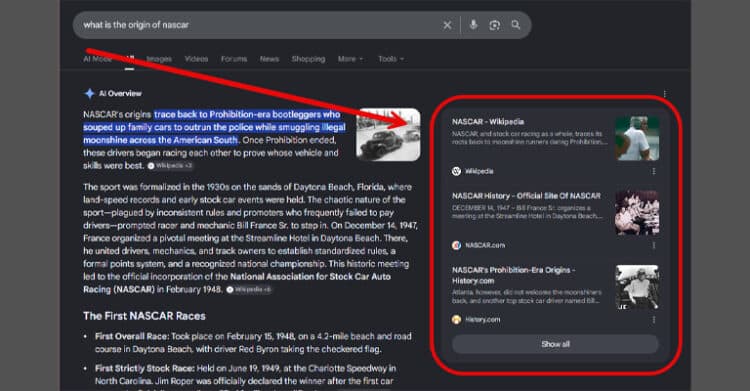
Being cited is the new ranking. So how do AI search engines pick which sources to use? The factors overlap with traditional SEO, but their weighting differs.
Signals That Influence Citation
- Direct answers near the top of the page that match the user’s question
- Clear heading structure with H2 and H3 headings that signal sub-topics
- Defined entities, meaning clearly named people, places, brands, and concepts, are used consistently throughout the page
- Authoritative external links and a strong backlink profile
- Structured data, which is code that labels what your content is about, so engines can understand it more easily
- Freshness, since AI engines often weigh recent content more heavily
- Named authors with credentials and clear expertise on the topic
If-Then Decision Rules for Content
If a passage answers the user’s question in fewer than 60 words, then it is more likely to be quoted. If a section uses clear subheadings that match common questions, then it is more likely to be retrieved.
If your content includes contradictory statistics, then AI engines may skip it to reduce hallucination risk. If your page has no named author, weak schema, or thin backlinks, then it rarely survives the citation stage.
Why Citation Matters More Than Ranking
Conductor’s 2026 AEO benchmark report analyzed 13,770 domains and 3.3 billion sessions. The headline finding: AI referral traffic converts at roughly two times the rate of traditional organic search (Conductor). Independent blogs and niche publishers earn meaningful citation share, especially for long-tail questions. That gap is the opportunity for smaller sites.
The Major AI Search Engines and How They Compare
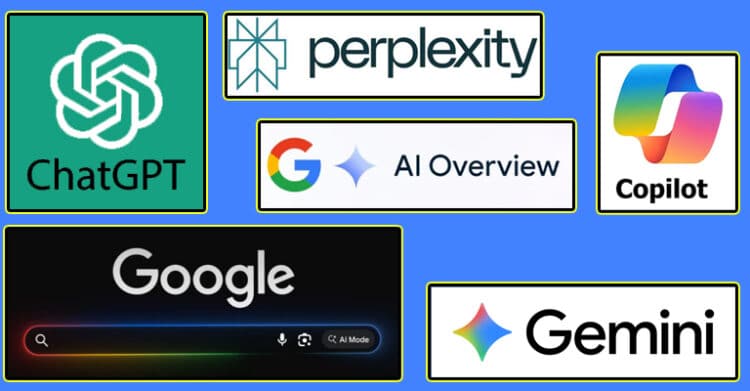
The AI search landscape now has several major players. Each follows the same general architecture, but they differ in scale, citation style, and audience.
| Tool | What It Is and Who Uses It |
| ChatGPT Search | OpenAI’s search product is layered on the ChatGPT chat experience. More than 900 million weekly active users as of Q2 2026, putting the monthly base above one billion. Processes around 2.5 billion prompts daily. |
| Perplexity AI | Citation-first AI search. Around 30 to 34 million monthly active users as of early 2026, up sharply year over year. Popular with researchers, analysts, and developers for transparent sourcing. |
| Google AI Overviews | AI-generated summaries inside Google’s standard results page. Reaches 2.5 billion monthly users worldwide as of May 2026, per Google’s I/O 2026 announcement. |
| Google AI Mode | A separate Google interface that replaces the link list with a conversational answer. Surpassed one billion monthly users in May 2026, just one year after launch. |
| Microsoft Copilot | Bing’s AI search experience, built on OpenAI models. Strong in enterprise contexts through Microsoft 365 integration. |
| Gemini | Google’s standalone chatbot, separate from AI Overviews. Reached 900 million monthly active users as of May 2026, more than double its base from a year earlier. |
The shared lesson across all of them: optimize for retrieval first, then for citation. Technical SEO basics like crawlability, structured data, and fast load times are still the entry ticket. AI search builds on top of, not in place of, those foundations.
What This Means for Your Content Strategy

AI engines retrieve in chunks, generate from passages, and cite based on clarity. Your content should match that pattern. Here is how to translate the mechanics into practice.
Write Direct Answers Early
Lead each section with a short, direct answer. Two or three sentences work well. Then explain, give examples, and add nuance. This pattern matches how AI engines extract passages. It also aligns with how user search intent has evolved across platforms.
Structure for Retrieval, Not Just Ranking
Use H2 and H3 headings that mirror real questions. Keep paragraphs short. Use lists and tables for extractable content. Each section should stand on its own since chunks are pulled in isolation.
Build Topical Authority With Internal Links
AI engines value entity authority. Connect related posts with descriptive anchor text. A strong content marketing strategy uses internal links to map relationships between topics. That helps both human readers and AI retrievers understand your coverage.
Keep Stats and Sources Current
AI search engines prefer fresh, well-sourced content. Cite recent reports. Refresh stats at least once a year. Outdated or unsourced claims are red flags that push your content out of consideration during re-ranking.
Common Mistakes Marketers Make With AI Search

Most marketers either ignore AI search entirely or chase it with tactics that backfire. Here are the patterns I see most often.
Treating AI Search Like a New Channel
AI search is not a separate channel. It runs on top of the same content you publish for traditional SEO. Building parallel content for AI rarely works. Improving the content you already have works much better.
Stuffing Pages With FAQ Schema
Adding FAQ schema does not automatically earn citations. The questions and answers still have to be useful, accurate, and well-written. Schema is a signal, not a shortcut.
Ignoring Author and Source Credibility
AI engines lean heavily on trust signals. Pages without named authors, contact info, or clear sources often get skipped. This connects to broader personal branding work, since a recognizable author boosts the odds of earning a citation.
Writing for AI, Not for People
Robotic, list-heavy content tuned for extraction feels artificial to human readers. AI engines still favor content that humans engage with. Engagement signals feed back into ranking and retrieval. Write for the reader first, then format for retrieval.
Forgetting the Basics
Slow load times, broken indexing, and poor mobile experience kill your AI search visibility. The LLM never even sees your content. The fundamentals of mobile-first indexing and Core Web Vitals still apply. Get those right before chasing AI-specific tactics.
People Also Ask

Here are the big-picture questions marketers most often ask about AI search.
Do AI search engines replace traditional SEO?
No. AI search engines build on top of traditional indexing and ranking. The same content that ranks well in Google is more likely to be cited by an AI engine. You should treat AI search as an extension of your SEO work, not a replacement.
How do AI search engines find new content?
They rely on the same crawlers traditional engines use. Google’s AI Overviews and AI Mode use Google’s existing index. ChatGPT Search and Perplexity use a mix of partner indexes and their own crawlers. Standard SEO best practices for indexing still apply.
Can I block AI search engines from using my content?
In some cases, yes. Your robots.txt file is a small text file on your site that tells crawlers which pages they can read. You can block specific AI crawlers, such as GPTBot, PerplexityBot, and Google-Extended, in that file. Keep in mind that blocking can also reduce citations and referral traffic from those engines.
What is the difference between AEO and GEO?
Answer engine optimization, or AEO, focuses on direct-answer features like featured snippets and AI overviews. Generative engine optimization, or GEO, specifically targets LLM-driven search experiences. The two overlap heavily in practice, which is why AEO is often used as an umbrella term.
Are AI search results trustworthy?
They are improving, but not perfect. RAG reduces hallucinations by grounding answers in real sources. Even so, newer reasoning models can hallucinate up to 79 percent of the time (The New York Times). Reasoning models are LLMs designed to think through complex problems step by step. Always verify important facts by clicking through to the cited source.
Will AI search engines kill organic traffic?
They will reshape it. Some informational queries that used to drive clicks now end at the AI summary. However, AI referral traffic tends to convert at much higher rates than traditional organic. Users arrive with deeper intent (Conductor). Fewer visits, but more valuable visits.
Quick Checklist: Make Your Content AI-Search Ready
Use this checklist as a final pass before publishing. Each item maps to one of the mechanics covered above.
| Task | |
| ☐ | Direct answer in the first 100 words of each section |
| ☐ | H2 and H3 headings that match real user questions |
| ☐ | Defined entities and consistent terminology throughout |
| ☐ | Short paragraphs, ideally two to four sentences each |
| ☐ | FAQ section with clear, one-to-three-sentence answers |
| ☐ | Named author with credentials and contact information |
| ☐ | Schema markup that matches the content type |
| ☐ | At least one recent, authoritative source cited per major claim |
| ☐ | Internal links that connect related posts on your site |
| ☐ | Mobile-friendly layout that loads quickly on any device |
Bringing It All Together
AI search engines are not magic. They are LLMs paired with retrieval systems, working in a clear five-step flow. Once you understand that flow, the optimization moves no longer feel random. They start to feel obvious.
Write direct answers. Structure for retrieval. Build authority through entities and internal links. Keep your sources current. The same disciplines that built strong organic traffic still apply, with a few new layers stacked on top.
Next step: pick your highest-traffic post and run it through the checklist above. Then walk through the broader answer engine optimization framework to layer on the strategic pieces. Small structural changes, applied consistently, compound visibility in AI search.
Frequently Asked Questions

What is an AI search engine in simple terms?
An AI search engine answers your question with a written response. It does not just hand you a list of links. Behind the scenes, it uses a large language model to read your question. It then pulls relevant content from the web in real time. Finally, it writes a clear answer with citations you can verify on your own. ChatGPT, Perplexity, and Google AI Overviews are all examples.
How is RAG different from a regular LLM?
A regular LLM answers only with what it learned during training. That means the information can be months or years out of date. RAG, or retrieval-augmented generation, fixes this gap. It lets the model look up fresh information from the web in real time. The model then uses that retrieved content to write a grounded answer with real sources behind every claim.
What does “grounding” mean in AI search?
Grounding forces the AI model to base its answer on retrieved sources. It does not lean only on its internal predictions. The practical benefit is fewer hallucinations and more accurate answers. Each claim in the response can be traced back to a real document. For users, this means answers are easier to verify. For publishers, it means clear writing earns more citations.
Why do AI engines retrieve content in chunks?
Chunking lets the engine pull just the relevant section of a long article. The engine does not need to ingest the full page to use part of it. Chunking also fits within the model’s context window. That window is the maximum text the LLM can read at once. Smaller, focused passages with clear headings tend to be retrieved more often than long, unbroken blocks.
What is a vector embedding?
A vector embedding is a list of numbers that represents the meaning of a piece of text. Picture each piece of content sitting at a point on a giant multi-dimensional map. Texts with similar meanings cluster close together. AI search engines use embeddings to match content based on meaning rather than exact words. This is what lets “canine” match a query about dogs.
Do I need to use schema markup for AI search?
Schema markup helps. It gives AI engines a clearer view of your content’s structure and entities. FAQPage, Article, and HowTo schema are the most useful for AI search visibility right now. Structured data serves as a clear signal that improves the odds of retrieval. Still, schema is a signal, not a shortcut. The underlying content has to be accurate and useful first.
How often should I update my content for AI search?
Refresh stats, examples, and screenshots at least once a year. For fast-moving topics like AI, every six months is safer. AI engines favor recent content and may demote pages with outdated claims. Watch for new platform launches, algorithm shifts, and changing market data. A quick quarterly audit catches the most important changes. Also, it’s vital to update internal links as new related posts go live.
Can small sites compete in AI search?
Yes. AI engines often cite niche publishers for long-tail questions because major sites do not cover them in depth. Clear writing, strong entity signals, and a defined focus give small sites a real shot. Niche authority matters more than total domain size. Build deep coverage of a tight topic cluster, use named authors, and earn a few quality backlinks. Citations will follow.
Should I optimize for ChatGPT or Perplexity first?
Optimize for clarity first, then check both. The same structural moves that work for one tend to work for the other. Perplexity surfaces citations more visibly, so it can drive more referral traffic per citation. ChatGPT has far more users but lighter source attribution. If your audience is researchers or analysts, prioritize Perplexity. For broad consumer audiences, ChatGPT and Google AI Overviews matter more.
What’s the future of AI search?
Agentic search is next, meaning AI tools that take actions rather than just returning answers. At Google I/O 2026, Google announced Search Agents. These tools monitor the web 24/7 and can complete tasks like booking on your behalf (Google). Expect more multimodal inputs, meaning queries that combine different formats like text, images, video, and even Chrome tabs. Expect citation patterns to keep shifting as models update. The brands cited consistently today will hold the edge as features expand.
Glossary
Bookmark this section for the key terms used throughout the post.
| Term | Definition |
| AI Search Engine | A search system that uses a large language model to generate written answers grounded in retrieved sources. |
| Large Language Model (LLM) | An AI model trained on huge amounts of text to understand and generate human-like language. |
| Retrieval-Augmented Generation (RAG) | An architecture that pairs an LLM with a real-time retrieval system to ground answers in fresh sources. |
| Vector Embedding | A list of numbers that represents the meaning of a piece of text in a way machines can compare. |
| Semantic Search | A search method that matches by meaning rather than by exact keyword. |
| Hybrid Search | A search approach that combines keyword matching with vector matching for better recall. |
| Chunking | Breaking content into smaller passages so they can be indexed and retrieved independently. |
| Grounding | Forcing an AI model to rely on retrieved sources when generating an answer. |
| Hallucination | A false or made-up output from an AI model that sounds plausible but is not supported by sources. |
| Cosine Similarity | A math function that measures how similar two vectors are, used to rank semantic search results. |
| Answer Engine Optimization (AEO) | The practice of optimizing content for direct-answer features and AI search experiences. |
| Backlinks | Links from other websites pointing to a page that signal authority, influence, ranking, and citation. |