
Quick Answer
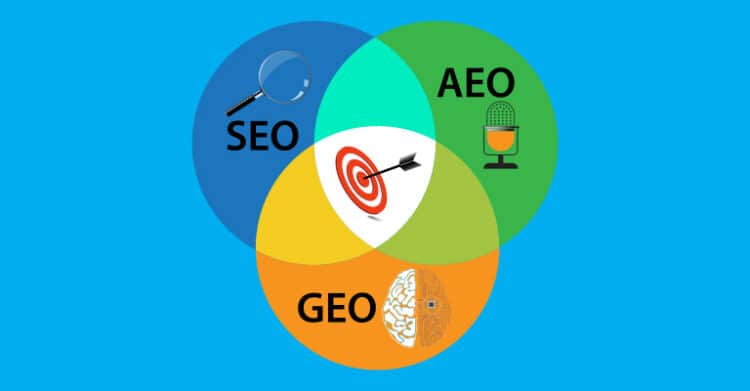
Content optimization covers three main approaches: search engine optimization (SEO), answer engine optimization (AEO), and generative engine optimization (GEO). SEO helps your content rank in traditional search results. AEO positions your content for featured snippets and voice search. GEO optimizes your content to appear in AI-generated responses. Each approach targets a different search experience. All three work best together.
Key Takeaways
- SEO, AEO, and GEO are types of content optimization that each target a different search surface.
- SEO focuses on ranking in traditional search engine results pages (SERPs).
- AEO targets featured snippets, voice search results, and zero-click answers.
- GEO optimizes content for citation or reference in AI-generated responses.
- All three require clear writing, keyword alignment, and user intent alignment.
- You do not need to choose between them. A strong content strategy layers all three.
- As AI search grows, combining AEO and GEO with traditional SEO gives you a competitive edge.
Table of Contents
Search has changed. Ranking on page one used to be enough. Now your audience finds information through voice assistants, AI chatbots, and featured snippets before they ever click a link.
That means one type of content optimization is no longer enough. You need to understand SEO, AEO, and GEO, and how they work together.
This guide breaks down each type of content optimization. You will learn what makes them different, what they share in common, and how to apply all three in your strategy.
What Are the Types of Content Optimization?
Content optimization is the process of improving your content to reach more of your target audience. The three main types are SEO, AEO, and GEO.
Each type targets a different kind of search experience:
- SEO (Search Engine Optimization) targets traditional search engine results pages.
- AEO (Answer Engine Optimization) targets direct answers, voice results, and featured snippets.
- GEO (Generative Engine Optimization) targets AI-generated responses from tools like ChatGPT, Perplexity, and Google Gemini.
All three types share a common goal: helping the right audience find your content. They each fit within a broader content marketing strategy, but each one requires a different approach to writing, structure, and execution.
What Is SEO and How Does It Optimize Content?
SEO, short for search engine optimization, is the process of improving your content so it ranks higher in traditional search results. It relies on keywords, site structure, backlinks, and technical factors like site speed and mobile-friendliness.
How SEO Works
Search engines use automated programs called crawlers to scan web pages. These crawlers index your content (meaning they store and catalog it) and rank it based on hundreds of signals.
The most important SEO factors include:
- Keyword relevance: Your content must match the terms your audience searches for.
- Content quality: Search engines favor helpful, well-structured content.
- Backlinks: Links from trusted sites signal credibility. Earning them is the core focus of off-page SEO.
- Technical SEO: Site speed, mobile-friendliness, and clean code all affect rankings.
- User experience: Metrics like dwell time and click-through rate influence rankings.
What Makes SEO Unique
SEO requires natural keyword use, supporting pages (related posts that reinforce your main content), internal links, and a technically sound website.
Organic search drives over 53% of all website traffic (BrightEdge). That makes SEO the foundation of most content strategies.
SEO is a long-term investment. You typically see results within 3 to 6 months of publishing and optimizing content.
What Is AEO and How Does It Differ from SEO?

AEO (Answer Engine Optimization) is the practice of optimizing content so search engines and voice assistants can extract and display direct answers. AEO requires clear, concise, question-based formatting.
How AEO Works
Answer engines do not just rank pages. They extract answers directly from content and display them without a click. These displays include:
- Featured snippets at the top of Google results
- Voice search responses from Siri, Alexa, or Google Assistant
- AI Overviews in Google Search
- “People Also Ask” panels
To win these placements, your content must answer specific questions clearly. Definitions, numbered steps, and short paragraphs work best.
When an AI Overview appears in search results, it reduces the click-through rate for the top-ranking page by 58% (Ahrefs). When AI Overviews appear, they absorb clicks that would otherwise go to the top organic result. The way to stay visible is to be the source cited in those answers. That makes earning direct answer placements more important than ever.
How AEO Differs from SEO
SEO focuses on ranking a full webpage. AEO focuses on formatting individual answers for direct extraction.
If a user asks, “What is content optimization?” and your page has a clear definition, Google may show it as a featured snippet. That requires AEO, not just SEO.
Key AEO tactics include:
- Starting answers with a direct definition or response
- Using question-based headings (H2s and H3s)
- Keeping answer paragraphs under 50 words
- Adding schema markup like FAQPage or HowTo to your pages (Google Search Central).
AEO and SEO are not competing strategies. AEO works best when built on top of a solid SEO foundation, and your blog is one of the best places to apply it. Consistent publishing strengthens all three optimization types, a core benefit of blogging for any content strategy.
What Is GEO and Why Does It Matter Now?

GEO (Generative Engine Optimization) is the practice of optimizing content so large language models (LLMs), the AI systems that power tools like ChatGPT, reference or cite it in their responses. GEO targets tools like ChatGPT, Perplexity, and Google Gemini.
How GEO Works
Generative AI tools pull from a wide range of online sources. When a user asks a question, the AI synthesizes information into a response. If your content is authoritative and well-structured, it is more likely to be cited.
GEO tactics focus on:
- Writing quotable, statistic-rich content with clear attribution
- Covering topics comprehensively with structured sections
- Mentioning specific brands, people, and tools by name so AI systems can identify what your content is about
- Publishing on established, authoritative websites that search engines already recognize and display in results
- Including clear summary statements that are easy to extract
How GEO Differs from SEO and AEO
SEO optimizes for search engine rankings. AEO optimizes for direct answer extraction. GEO optimizes for AI synthesis and citation.
GEO is newer than SEO and AEO. It emerged alongside the rapid growth of AI search tools.
Nearly 40% of Americans use at least one AI chatbot every month (SparkToro). That is a large and growing audience.
The quality of that traffic is just as notable as the size.
AI search visitors convert at 23 times the rate of traditional organic search visitors. Despite making up just 0.5% of total traffic, they generated 12.1% of all signups in one study (Ahrefs). If your content earns AI citations, that traffic is highly valuable.
Domain authority also plays a role in GEO. A strong personal branding guide can help you build the credibility signals that make AI tools more likely to cite your content.
How Do SEO, AEO, and GEO Compare?
Understanding the differences helps you build a smarter content strategy. The table below summarizes all three types of content optimization.
| Primary Goal | Format Focus | Target Platform | Success Metric | |
| SEO | Rank in search results | Keywords, structure, links | Google, Bing | Organic traffic, rankings |
| AEO | Win direct answer placements | Concise Q&A, definitions | Google Snippets, voice search | Snippet wins, impressions |
| GEO | Appear in AI responses | Authoritative, quotable content | ChatGPT, Perplexity, Gemini | AI citations, brand mentions |
What SEO, AEO, and GEO Have in Common
All three types of content optimization share these core principles:
- Clear, well-structured writing: All three favor organized, easy-to-read content.
- User intent alignment: Each approach requires you to understand what your audience wants.
- Factual accuracy: Unverified claims hurt your standing with search engines, answer engines, and AI models alike.
- Consistent publishing: All three reward content programs that publish regularly.
Where They Differ
The key difference is where your content is displayed and how it is consumed:
- SEO surfaces your full page in a ranked list of results.
- AEO surfaces a short answer from your page before the user clicks.
- GEO synthesizes your content into an AI response that may or may not credit you by name.
How Do You Use All Three Together?
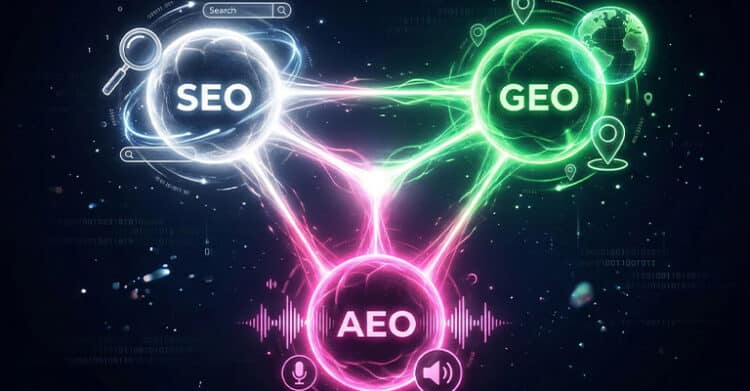
The most effective content strategy does not choose between SEO, AEO, and GEO. It layers all three into every piece of content you publish. Good blog audience research makes this easier by showing you exactly what questions your readers are asking and how they phrase them.
A Practical Framework
Follow this process for every pillar post or long-form article:
- Start with keyword research (SEO). Identify the primary keyword, search volume, and user intent before you write.
- Structure for direct answers (AEO). Use question-based headings, a clear intro definition, and a concise FAQ section.
- Build authority signals (GEO). Include statistics with source attribution. Cover the topic thoroughly. Write in clear, quotable sentences.
- Review your formatting. Make sure your page is easy to crawl and easy to scan. It should be detailed enough to earn AI citations.
- Publish and promote. Backlinks and shares still matter. They signal authority to both search engines and AI indexers. Influencer marketing is one of the most effective ways to earn them.
If/Then Decision Rules
Use these rules to prioritize your effort:
- If your main goal is organic traffic growth, prioritize SEO fundamentals first, then layer in AEO tactics.
- If your audience uses voice search or gets answers from Google Snippets, build AEO into every post from day one.
- If your audience uses AI tools for research, treat GEO as a required part of your content quality standard.
All three types require clear writing, alignment with user intent, and consistent publishing. The difference is where you focus your formatting efforts.
Common Mistakes to Avoid with Content Optimization

Most content teams make the same mistakes. Avoiding them helps you get better results across SEO, AEO, and GEO.
Treating SEO as the Only Strategy
Focusing only on keyword rankings ignores the growing share of searches that never reach a ranked result. Featured snippets and AI Overviews now intercept many queries before a click happens.
If you only optimize for rankings, you miss where much of your audience now searches.
Writing for Bots Instead of People
Keyword stuffing, awkward phrasing, and prioritizing technical signals over readability all backfire. Search engines, answer engines, and AI models favor clear, natural writing.
Write for your reader first. Optimization comes second.
Ignoring Schema Markup
Schema markup helps search engines and AI tools understand your content. Without it, you reduce your chances of winning featured snippets or AI citations. Add Article, FAQPage, and HowTo schema where appropriate. Free implementation guides are available for each type (Google Search Central).
Skipping Source Attribution
GEO rewards content that cites credible sources. If you make factual claims without attribution, AI tools are less likely to use your content as a reference.
Link to primary sources. Include clear attribution inline throughout your posts.
People Also Ask
What is the difference between SEO and AEO?
SEO focuses on ranking a web page in traditional search results. AEO focuses on formatting content so search engines can extract and display a direct answer without requiring a click.
Is GEO the same as SEO?
No. SEO optimizes content for algorithmic search rankings. GEO optimizes content for citation or reference by AI systems such as ChatGPT and Perplexity.
Do I need to do all three types of content optimization?
You do not need to treat them as separate projects. Build SEO, AEO, and GEO tactics into the same piece of content from the start.
Which type of content optimization should beginners start with?
Start with SEO. It provides the technical and strategic foundation on which AEO and GEO build. Once you understand keyword research and site structure, layering in AEO and GEO becomes straightforward.
What is GEO in digital marketing?
GEO stands for Generative Engine Optimization. It is the practice of optimizing content to appear in AI-generated responses from tools like ChatGPT, Google Gemini, and Perplexity.
How is AI search changing content optimization?
AI search tools summarize and synthesize content rather than just ranking it. Content optimized only for rankings may be skipped by users who get answers directly from AI tools.
Conclusion
Content optimization has expanded well beyond traditional search rankings. SEO, AEO, and GEO each serve a different part of the search experience. Together, they form a complete visibility strategy for the landscape you operate in today.
Start with a strong SEO foundation. Build your content around clear, question-based structures that support AEO. Then add depth, statistics, and clarity to meet the GEO standard that AI tools reward.
Marketers who understand all three types of content optimization will stay visible as search continues to evolve.
Ready to build your foundation? Explore the full SEO strategy guide to start putting these principles into practice.
FAQ

What does content optimization mean?
Content optimization is the process of improving your content to perform better in search results. It covers three areas: traditional search rankings (SEO), direct answer placements (AEO), and AI-generated responses (GEO). Good content optimization aligns your writing with what your audience is searching for. It also improves the structure, clarity, and credibility of your content. The goal is to reach the right people across every search surface.
What are the three types of content optimization?
The three main types are SEO, AEO, and GEO. SEO helps your content rank in traditional search results. AEO formats your content to appear in featured snippets and voice search. GEO optimizes your content for citation by AI tools like ChatGPT and Perplexity. Each type targets a different search surface, but all three work together in a strong content strategy.
What is SEO in content optimization?
SEO stands for Search Engine Optimization. It is the practice of improving your content and website so search engines rank it higher. SEO involves using the right keywords, building backlinks, optimizing site speed, and writing content that addresses user intent. It is the foundation of most content strategies. Without SEO, your content is unlikely to reach your audience through traditional search.
What does AEO stand for?
AEO stands for Answer Engine Optimization. It is the practice of formatting content so search engines and voice assistants can extract and display direct answers. When you use question-based headings and concise definitions, you increase your chances of appearing in featured snippets and voice results. AEO works alongside SEO rather than replacing it. Think of AEO as the layer that makes your well-ranked content even more visible.
What does GEO stand for in digital marketing?
GEO stands for Generative Engine Optimization. It is the practice of optimizing content to appear in AI-generated responses from tools like ChatGPT, Google Gemini, and Perplexity. GEO focuses on writing authoritative, quotable content with clear source attribution. AI tools are more likely to cite content that is factually accurate, well-structured, and comprehensive. As AI search grows, GEO is becoming a key part of any forward-looking content strategy.
How is AEO different from traditional SEO?
Traditional SEO ranks a full web page in search results. AEO formats specific answers within that page to be displayed directly. For example, a well-structured FAQ section may appear as a featured snippet in Google results. SEO drives people to your site. AEO shows them the answer before they even arrive. Both matter, and they work best when used together in the same piece of content.
How do I optimize content for AI search?
To optimize for AI search (GEO), focus on four things. First, write clearly and factually with inline source attribution. Second, structure your content with descriptive headings and logical sections. Third, include statistics and definitions that AI tools can extract easily. Fourth, publish on a trusted, indexed domain with strong backlinks. AI tools prefer content that is thorough, credible, and easy to read. Consistent publishing also signals that your site is reliable.
Does social media affect SEO, AEO, or GEO?
Social media does not directly affect search rankings. However, social shares increase the visibility of your content, which can lead to more backlinks. Those backlinks support SEO. Higher visibility also increases the likelihood that your content will be indexed and cited by AI tools, which supports GEO. Think of social media as an amplifier. It does not replace optimization, but it can extend the reach of well-optimized content.
What is schema markup and why does it matter?
Schema markup is code you add to your web page to help search engines and AI tools understand your content. It labels your content type, whether it is an article, a FAQ, or a how-to guide. With schema markup, you improve your chances of appearing in featured snippets and rich results. This supports both AEO and GEO. Free documentation and implementation examples are available for each schema type (Google Search Central).
How long does content optimization take to show results?
SEO typically takes 3 to 6 months before you see meaningful results. The timeline depends on your domain authority, competition, and the consistency of your publishing. AEO results can appear faster if your content is already well-structured and indexed. GEO results are harder to measure directly, but strong content with clear attribution can be cited by AI tools within weeks of publishing. Consistent effort over time produces the most lasting outcomes.
Can small businesses compete using these optimization types?
Yes. Small businesses often compete well in specific niche topics. Larger sites tend to target broad, high-competition keywords. If you focus on a narrow subject and cover it thoroughly, you can rank in search results, win featured snippets, and earn AI citations. The key is consistency and depth. A small site with 20 well-optimized posts on a focused topic can outperform a large site with hundreds of shallow articles.
Is it possible to over-optimize content?
Yes. Over-optimization happens when you force keywords into your writing or use unnatural phrasing. These tactics can trigger search engine penalties or cause AI tools to ignore your content. The best approach is to write naturally for your reader first. Then review your content to confirm it follows SEO, AEO, and GEO best practices. Helpful, readable content consistently outperforms content that feels forced or artificial.
Glossary
| Term | Definition |
| Search Engine Optimization (SEO) | The practice of improving content and website structure to rank higher in traditional search engine results pages. |
| Answer Engine Optimization (AEO) | The practice of formatting content so search engines and voice assistants can extract and display direct answers to user questions. |
| Generative Engine Optimization (GEO) | The practice of optimizing content to be cited or referenced by AI tools like ChatGPT, Perplexity, and Google Gemini. |
| Featured Snippet | A boxed result at the top of Google search results that displays a direct answer extracted from a web page. |
| Schema Markup | Structured code added to a web page to help search engines understand the content type and context. |
| AI Overview | A feature in Google Search that uses generative AI to summarize information from multiple sources at the top of a results page. |
| Zero-Click Search | A search query where the user gets their answer on the results page without clicking any link. |
| User Intent | The underlying goal behind a search query, which can be informational, navigational, or transactional. |
| Large Language Model (LLM) | An AI system trained on large amounts of text data that generates human-like responses to questions. |
| SERP (Search Engine Results Page) | The page a search engine displays in response to a query, showing ranked results, ads, and enriched features like snippets. |